HV Wire Immersive Engineering
A common mistake among early Immersive Engineering users is assuming that all power transmission methods offer the same flexibility or safety features. However, when it comes to High Voltage (HV) Wire, the highest tier of power transmission in Immersive Engineering, a distinct set of rules and limitations applies that sets it apart from its lower-tier counterparts.
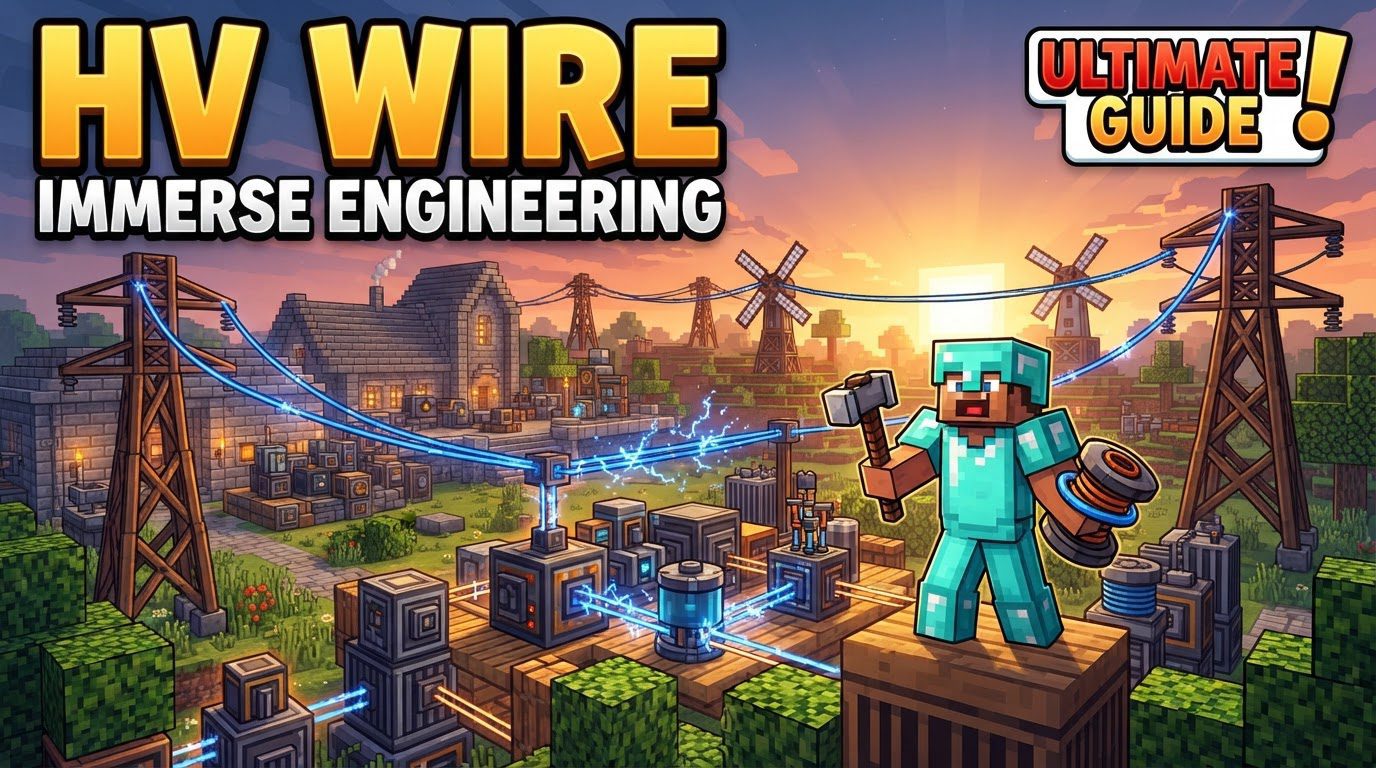
The Apex of Power: Understanding HV Wire Coils
HV Wire Coils represent the pinnacle of power transmission within Immersive Engineering. Designed for moving substantial amounts of Redstone Flux (RF) across your base, they are indispensable for large-scale operations. A single HV Wire Coil segment boasts an impressive continuous transfer rate, capable of moving a maximum of 32,768 RF per tick. This makes them ideal for connecting high-demand machines or channeling the output of powerful generators.
Despite their power, HV Wire Coils come with a physical constraint: each individual segment has a maximum length limit of 32 blocks. Spanning distances greater than this requires careful planning and the use of specialized components. Furthermore, power transmission isn’t entirely lossless. HV Wire Coils incur a minor energy loss of 0.078% RF per block distance. While seemingly small, this accumulates to a maximum loss of 2.5% over their full 32-block length, a factor to consider in extremely large or complex power grids.
A critical characteristic of HV Wire Coils, distinguishing them from LV and MV wires, is their inherent lack of insulation. Unlike the lower tiers, HV Wire Coils cannot be crafted into an insulated version. This means they are always exposed, which has a significant implication: powered HV Wire Coils cause damage to mobs that walk into them. While this can sometimes be a convenient perimeter defense, it also means they require careful placement to avoid unintended harm or disruption.
Essential Components of an HV Network
Building an effective HV power grid relies on more than just the wires themselves. Several key components work in conjunction to create a robust and reliable system.
HV Wire Connectors
- Function: These are the interface points of your HV network. HV Wire Connectors are responsible for linking machines, generators, and capacitors to the wire network.
- Placement: They attach directly to power plugs found on Immersive Engineering machines or other compatible power-handling blocks.
- Limitation: A crucial detail to remember is that HV Wire Connectors can only support one wire at a time. This means you cannot branch multiple wires off a single connector; for branching, you’ll need relays.
HV Wire Relays
- Function: HV Wire Relays are pivotal for extending transmission distances and managing complex power layouts. They are used to connect multiple HV Wire Coils together, effectively allowing for the splitting or joining of segments.
- Distance Extension: Since individual wire segments are limited to 32 blocks, relays become indispensable for extending your power grid over longer distances. By placing a relay at or before the 32-block mark, you can start a new 32-block segment.
- Branching: Unlike connectors, relays facilitate the branching of power lines, allowing you to distribute power to multiple destinations from a single point in your main line.
- Passive Role: It’s important to note that HV Wire Relays themselves do not input or output RF. Their sole purpose is to act as intermediate connection points for the wire coils.
Navigating Voltage Tiers and Power Conversion
Immersive Engineering operates on a strict system of distinct voltage tiers: Low Voltage (LV), Medium Voltage (MV), and High Voltage (HV). This system dictates how power flows and what components can connect to each other.
- Strict Compatibility: Wires and connectors are tier-specific. This means HV wires will only connect to HV Wire Connectors, and similarly, HV Connectors will only accept HV wires. Equipment with different voltage ratings cannot be mixed directly; attempting to do so will simply not establish a connection.
- Transformers for Tier Conversion: To convert power between these different voltage levels, you will need to utilize Transformers. For higher-tier conversions, such as from MV to HV, dedicated HV Transformers are necessary.
- Capacitors as Alternatives: Immersive Engineering capacitors offer a versatile and often superior alternative for voltage conversion. Many capacitors have built-in transforming capabilities, allowing them to convert power between different tiers while also providing valuable energy storage. They can be a cheaper and safer option compared to dedicated transformers, especially when you also need the added benefit of power buffering.
Building Your HV Network: A Step-by-Step Guide
Setting up an HV power grid is a straightforward process once you understand the components and their limitations.
- Place HV Wire Connectors: Begin by attaching HV Wire Connectors to the power input/output points of your machines, generators, or capacitors. Ensure they are correctly oriented to the power plugs.
- Place HV Wire Relays (if needed): For any distances greater than 32 blocks between your source and destination, or if you intend to branch off the power line, strategically place HV Wire Relays at intermediate points. Remember, relays facilitate branching and extend range.
- Connect Wires: With your connectors and relays in place, use an HV Wire Coil. Right-click on the first HV Wire Connector (or Relay) to initiate the connection, and then right-click on the second HV Wire Connector (or Relay) to establish the circuit. The wire will visually appear, confirming a successful link.
- Remove Wires: Should you need to reconfigure or remove a wire, simply use Engineer’s Wire Cutters. Right-click on an HV Wire Connector or HV Wire Relay that has a wire attached to it, and the wire segment will be safely disconnected.
Crucial Considerations and Common Pitfalls
While powerful, HV wires have several nuances that, if overlooked, can lead to inefficiencies or system failures.
- Exceeding Load Capacity: HV wires have a maximum transfer rate of 32,768 RF/tick. If the cumulative electrical load from connected machines exceeds this capacity, the wire will melt. While this does not cause damage to connectors or machines, it immediately interrupts power flow, requiring manual replacement of the melted segment. Always monitor your power load to prevent such disruptions.
- No Insulation Means Mob Damage: Unlike lower-tier wires, HV wires are inherently uninsulated. This means they will damage any mob that comes into contact with them. While this can be a minor defensive feature, it also means careful planning is needed to prevent accidental mob pathing through your power lines, which could lead to unexpected entity drops or damage to your base’s inhabitants.
- Incorrect Voltage Tiers: A fundamental rule in Immersive Engineering is voltage matching. Attempting to connect wires or machines of different voltage tiers directly will simply not work. Always ensure your connectors, wires, and machines are all rated for HV to avoid frustration.
- Relays are Mandatory for Long Distances: Forgetting the 32-block length limit is a common mistake. Trying to span too great a distance with a single HV wire segment will result in a failed connection. HV Wire Relays are not optional for long-distance power transmission; they are an absolute necessity.
- HV Connectors Support Only One Wire: Each HV Wire Connector can only handle a single wire connection. If you need to branch power off to multiple machines or directions from a single point, you must use an HV Wire Relay. This allows for the splitting or joining of multiple wire segments.
- Issues with Non-Immersive Engineering Machines: A particularly tricky issue can arise when HV connectors terminate in machines from other mods. There’s a known behavior where, after server restarts or world reloads, these connections may visually appear intact but cease to transfer power. This requires careful testing and potentially using an Immersive Engineering capacitor as an intermediate buffer for power transfer to external mod machines.
Conclusion
HV Wire in Immersive Engineering is a robust and efficient solution for high-capacity power transmission. By understanding its impressive transfer rate, appreciating the role of Connectors and Relays, and respecting its unique limitations – such as the 32-block length, lack of insulation, and strict voltage tiers – you can construct a powerful and reliable energy grid. Always prioritize voltage matching, plan for relays over long distances, and be mindful of the single-wire limitation of connectors to ensure your industrial endeavors are continuously and effectively powered.
Tags:
YOU MAY ALSO LIKE...