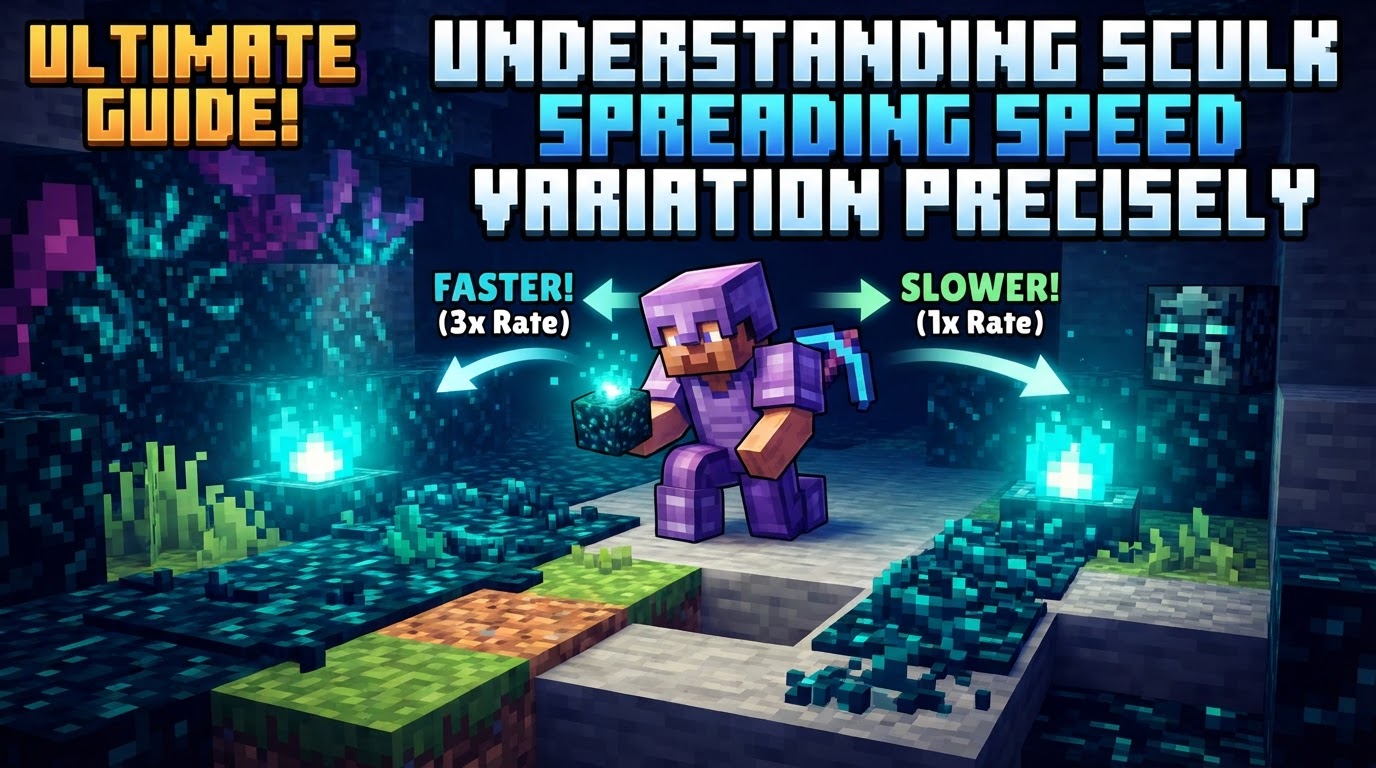
Understanding Sculk Spreading Speed Variation
Unlike natural Sculk Shriekers found deep within the Ancient Cities, those generated by a Sculk Catalyst will never summon the terrifying Warden. This crucial distinction highlights the unique control and utility a Sculk Catalyst offers, particularly when it comes to understanding and manipulating sculk’s spreading speed and extent.
The Heart of the Bloom: The Sculk Catalyst
At the core of all sculk propagation lies the Sculk Catalyst. This enigmatic block is the engine that drives the transformation of ordinary terrain into the eerie, pulsating biome of the Deep Dark. Without a Catalyst, sculk cannot naturally spread beyond its initial generation. The primary trigger for a Catalyst to activate its spreading capabilities is the death of any mob (or even a player, provided they drop experience points) within its activation radius. In Java Edition, this radius is 8 blocks, while in Bedrock Edition, it extends to 10 blocks. Once activated, the Catalyst absorbs the experience points (XP) dropped by the dying entity, converting this raw energy into the spread of sculk.
Experience Points: The Fuel for Spreading Speed
The most significant factor influencing both the speed and the ultimate extent of sculk spreading is the amount of experience points (XP) dropped by the deceased mob. This is where the “speed variation” truly comes into play. Mobs that yield a higher quantity of XP will cause the sculk to spread farther and with greater intensity. Imagine a basic zombie offering minimal XP versus a more formidable foe; the sculk bloom from the latter will be far more extensive and cover a larger area in a shorter amount of time, due to the increased “energy” absorbed by the Catalyst. This direct proportionality means that strategic mob farming near a Catalyst can result in rapid and widespread sculk generation, as the Catalyst processes and distributes the absorbed XP across the surrounding blocks.
The Canvas for Corruption: Replaceable Blocks
Sculk cannot spread onto just any block. Its growth is limited to specific “sculk_replaceable” blocks. These typically include common, less resilient blocks such as dirt, stone, gravel, and sand. Conversely, harder, more valuable blocks like various ores (iron, gold, diamond, etc.) and obsidian are completely impervious to sculk conversion. Understanding this limitation is vital for controlling the direction and boundaries of your sculk spread. If a Catalyst is surrounded by non-replaceable blocks, the spread will halt abruptly or be redirected along paths of suitable terrain. This inherent selectivity means that the composition of the surrounding environment directly dictates the potential spread, acting as a natural barrier or a clear pathway for the growing sculk.
The Blooming Process: What Sculk Becomes
When the Catalyst absorbs XP, it initiates a “blooming” process, converting adjacent sculk_replaceable blocks into various forms of sculk. This isn’t just a simple block-for-block replacement; the process can generate an array of distinct sculk blocks:
- Basic Sculk: The most common conversion, forming the foundation of the new biome.
- Sculk Veins: Thin, web-like structures that spread across surfaces, often indicating the initial stages of growth or connecting larger sculk patches.
- Sculk Sensors: These vibration-detecting blocks have a 1% chance of generating during the spread. They are crucial for redstone contraptions but can also be a nuisance if not managed.
- Sculk Shriekers: With a 9% chance of generation, these blocks emit a shriek when activated by a vibration. As mentioned, those generated by a Catalyst will NOT summon a Warden, unlike their naturally occurring counterparts, offering a unique opportunity for players.
The spread itself can be quite extensive, with observed distances reaching 75 blocks or more from a single Catalyst activation. Multiple “charges” from subsequent mob deaths can merge and compound the growth, leading to dense and far-reaching sculk formations. The pattern of spread often approximates a random walk model, meaning it’s somewhat unpredictable in its exact path but generally radiates outwards from the Catalyst, seeking out replaceable blocks.
Harnessing the Deep: A Guide to Intentional Sculk Spreading
For players looking to cultivate sculk for aesthetic reasons, XP storage, or even specific block generation, a systematic approach is key:
- Acquire a Sculk Catalyst: These blocks are found exclusively in Deep Dark biomes or Ancient Cities. Alternatively, they are dropped by defeating a Warden. Remember, you must use a Silk Touch enchanted tool to successfully collect the Catalyst; attempting to mine it with any other tool will destroy it.
- Strategic Placement: Place the Sculk Catalyst at your desired location for sculk growth. Consider the surrounding terrain and your goals.
- Ensure Receptivity: Before activating, confirm that the blocks immediately surrounding your Catalyst, and extending outwards, are indeed “sculk_replaceable.” This ensures maximum spread and prevents the growth from being prematurely halted.
- Trigger the Spreading: Cause a mob to die within the Catalyst’s activation radius (8 blocks in Java, 10 blocks in Bedrock). The higher the experience points dropped by the mob, the more significant the sculk spread will be. For extensive growth, consider setting up a mob farm that funnels high-XP mobs to their demise near the Catalyst.
Mastering the Pace: Influencing Sculk Spreading Speed and Extent
The variation in sculk spreading speed is predominantly a function of the XP input. To truly master this, consider these factors:
- XP Yield per Mob: This is the paramount factor. A single kill of a high-XP mob (e.g., an Ender Dragon or Wither, though impractical for sculk farming) would cause an explosive, rapid, and far-reaching bloom. Conversely, repeatedly killing low-XP mobs will result in a slower, more localized, and gradual spread. For efficient farming, target mobs that offer a good balance of XP and ease of production, such as zombie piglins in a gold farm.
- Frequency of Mob Deaths: Even with low-XP mobs, a high frequency of deaths will lead to a continuous and accelerating spread. The Catalyst can absorb multiple XP charges, which then contribute to the overall bloom, potentially merging and expanding existing sculk patches.
- Environmental Obstacles: The presence of non-replaceable blocks acts as a speed bump or a complete halt. A path of replaceable blocks allows for faster, unimpeded growth, while a patchy environment will result in a slower, more fractured spread as the sculk navigates around impervious terrain.
- Catalyst Density: While one Catalyst can spread sculk extensively, placing multiple Catalysts in proximity, each triggered by mob deaths, can lead to overlapping and combined spreads, effectively increasing the overall speed of area conversion.
Beyond the Bloom: Practical Applications and Smart Strategies
Understanding sculk’s mechanics opens up several strategic possibilities:
- XP Storage and Retrieval: Sculk blocks essentially store the absorbed XP. By breaking sculk blocks with any tool that does not have the Silk Touch enchantment, you can retrieve a portion of this stored XP. This makes sculk farms an effective, albeit unconventional, method for accumulating and storing experience points.
- Controlled Aesthetic Growth: Players can design specific sculk “gardens” or features by carefully placing Catalysts and controlling mob deaths, using non-replaceable blocks as boundaries.
- Warden-Free Shriekers: As highlighted, Sculk Shriekers generated by a Catalyst do not summon the Warden. This allows for the creation of redstone contraptions that utilize shriekers’ vibration detection without the terrifying consequence of attracting the Deep Dark’s apex predator.
- Stealth Tactics: When venturing into natural Deep Dark biomes or managing your own sculk farms, remember that wool blocks are invaluable. They absorb vibrations, preventing accidental activation of Sculk Sensors and Shriekers, which is crucial for maintaining stealth and avoiding unwanted attention.
Avoiding Common Pitfalls in Sculk Cultivation
Even seasoned players can make mistakes when dealing with sculk. Be mindful of these common errors:
- No Mob Death, No Spread: A Sculk Catalyst will not begin its work unless a mob dies within its radius and drops XP. Simply placing the Catalyst and waiting will yield no results.
- Incorrect Mining Tool: Attempting to mine a Sculk Catalyst without a Silk Touch enchanted tool will destroy the block, preventing you from collecting it for your own use.
- Unsuitable Blocks: Expecting sculk to spread onto blocks like ores, obsidian, or even certain crafted blocks is a common misconception. Sculk will only convert designated “sculk_replaceable” blocks.
- Confusion with Shulkers: Despite a superficial similarity in name, sculk and Shulkers are entirely distinct entities within Minecraft. Sculk is a biome-altering block system, while Shulkers are hostile mobs found in End Cities.
Mastering the intricacies of sculk spreading, particularly the pivotal role of experience points in dictating its speed and extent, transforms a mysterious Deep Dark mechanic into a powerful tool for creative builders and pragmatic resource gatherers alike. By understanding the Catalyst, the role of XP, and the environment, you can manipulate this unique block system to your advantage.
Tags:
YOU MAY ALSO LIKE...