What Causes Redstone Dust to Propagate Asymmetrically
Redstone signals in Minecraft rarely behave as perfectly uniform, omnidirectional pulses. Instead, they often exhibit what appears to be an asymmetric spread, favoring certain directions or abruptly stopping where one might expect them to continue. This phenomenon, while not formally termed “asymmetric propagation” within the game’s code, describes the practical reality of how redstone dust’s directional properties and underlying mechanics prevent signals from spreading equally in all directions. Understanding these nuanced behaviors is fundamental to mastering redstone circuitry, allowing engineers to build efficient and predictable contraptions rather than battling unexpected signal loss.
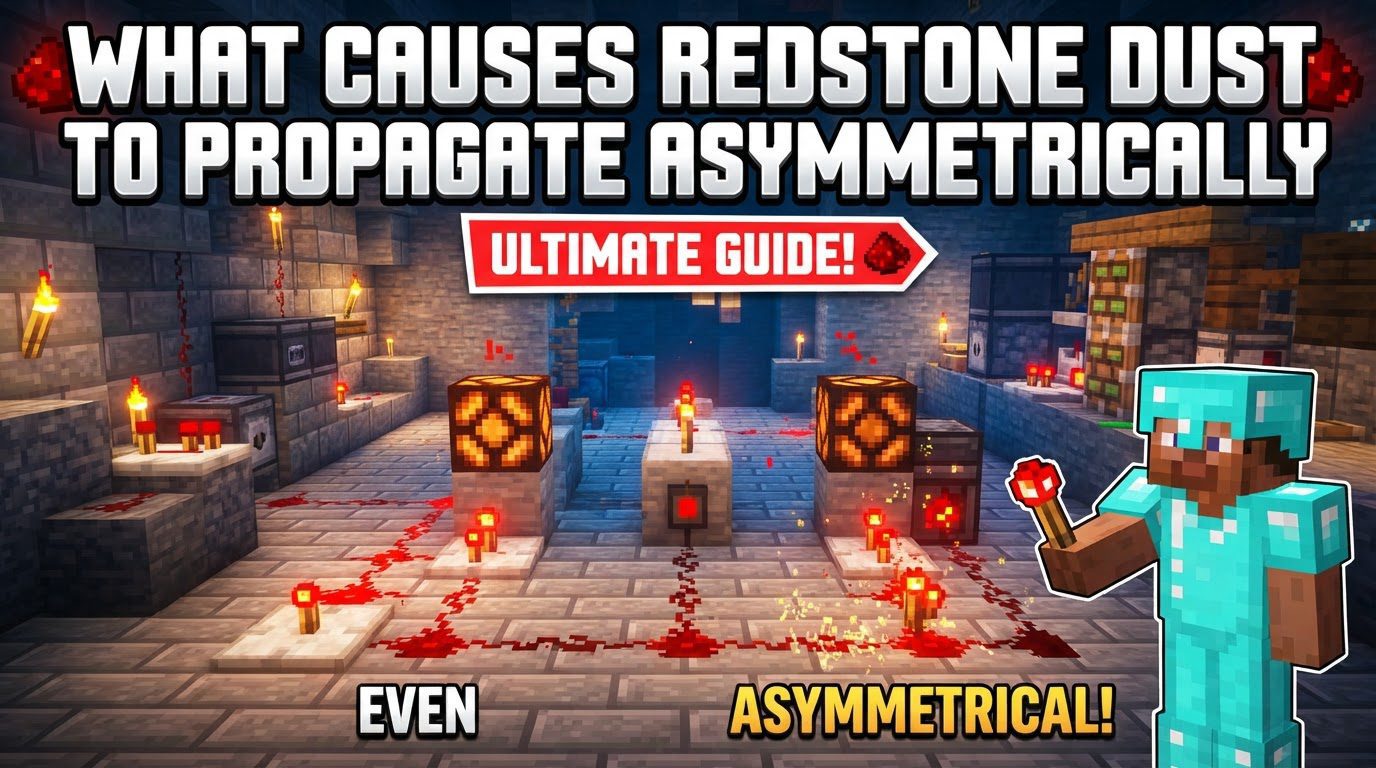
The Intricate Dance of Redstone Power: Why Signals Don’t Spread Evenly
The core of redstone’s seemingly asymmetric behavior lies in a few critical mechanics that govern how power is transmitted, diminished, and interpreted by blocks and components. These aren’t bugs, but deliberate design choices that give redstone its depth.
- Signal Strength and Decay: Every redstone signal possesses a power level ranging from 0 (off) to 15 (maximum strength). When power travels from one piece of redstone dust to an adjacent one, its strength decreases by one. This inherent decay means a redstone wire can only carry a signal for a maximum of 15 blocks before it dies out. This physical limitation immediately creates asymmetry; a signal will extend further in the direction of its path than it might to a side branch that quickly decays.
- Directional Powering of Dust: Redstone dust is not a simple, omnidirectional conductor. When placed, it attempts to connect to any adjacent redstone components or blocks. Its visual appearance-a cross shape when connected in all four cardinal directions, or a line when connected only in two-is a crucial indicator of its preferred propagation paths. Power primarily flows along these established connections, influencing which neighboring dust segments receive power directly from the source and which might be neglected or receive a weaker signal.
- The Critical Distinction: Weak vs. Strong Power: This is perhaps the most significant contributor to directional propagation. An opaque block directly powered by redstone dust becomes “weakly powered.” While a weakly powered block can activate specific redstone components like repeaters, comparators, or pistons, it critically cannot directly power other adjacent redstone dust. This contrasts sharply with “strongly powered” blocks, which receive power from sources like redstone blocks, redstone torch outputs, or repeater outputs. Strongly powered blocks *can* power adjacent redstone dust, creating a clear directional bias where weak power effectively acts as a signal dead-end for further dust propagation.
- Vertical Transmission Quirks: Redstone dust exhibits distinct behavior when propagating signals vertically. It can transmit a signal diagonally upward through non-opaque blocks (like air or glass). However, it generally cannot transmit power diagonally downward through opaque blocks. In Java Edition, transparent blocks also cannot pass power downward. This inherent bias towards upward propagation means that vertical circuits often require different designs for ascending vs. descending signals, creating a clear vertical asymmetry.
- Repeaters and Comparators: Imposing Direction: Redstone repeaters and comparators are specifically designed to manage signal flow. They transmit signals in only one direction, effectively acting as one-way gates. Furthermore, they always output a full signal strength of 15, regardless of the input strength (as long as it’s 1 or higher). This ability to refresh and direct signals is crucial for overcoming natural decay and imposing specific, often asymmetric, signal paths.
The Lifecycle of a Redstone Pulse: How Asymmetry Manifests
Understanding how these mechanics interact provides a step-by-step insight into why signals don’t spread uniformly:
- Initial Power Source Activation: A power source, such as a lever, button, or redstone torch, emits a redstone signal, typically at a power level of 15, into an adjacent block or piece of redstone dust.
- Dust Connection and Orientation: The redstone dust placed on a surface will visually connect to any adjacent dust or redstone components. Its visual form (cross, line, or dot) isn’t just aesthetic; it indicates its functional connections and, implicitly, its preferred paths for signal propagation. A signal will primarily travel along these established connections.
- Power Level Decrement: As the signal travels through each connected piece of redstone dust, its power level decreases by one. This progressive decay limits how far the signal can travel in any given direction.
- Directional Output and Weak Power: When redstone dust powers an adjacent opaque block, that block becomes weakly powered. This is where asymmetry becomes very apparent: while this weakly powered block might activate a piston or a repeater, it will NOT power any redstone dust placed directly on its other sides. This effectively creates a directional barrier for dust propagation, even if the signal is strong enough to continue elsewhere.
- Block Updates and Order of Operations: Minecraft processes redstone updates in a tick-based system. The precise order in which blocks are updated and signals are propagated can sometimes lead to transient, momentary asymmetric states. However, the final, stable state of the circuit should always be consistent with the underlying mechanics described above.
Engineering for Predictability: Tips for Redstone Builders
Mastering redstone means understanding and leveraging its directional properties. Here are practical tips for managing what appears to be asymmetric propagation:
- Leverage Repeaters for Consistent Direction and Strength: To ensure a signal travels reliably and with full strength in a specific direction, always use redstone repeaters. They act as one-way gates, forcing the signal to travel in a single direction, and refresh the signal to power level 15, overcoming decay.
- Master the Weak vs. Strong Power Distinction: This is a cornerstone of advanced redstone. Be acutely aware that redstone dust powers blocks weakly. If you need a block to power other redstone dust from its sides, it must be strongly powered. This typically requires a redstone block, a repeater output, or a redstone torch to power it directly.
- Plan for Verticality: When designing vertical circuits, understand that signals propagate more easily upward (especially diagonally through non-opaque blocks) than downward. For downward transmission, plan for staircases of blocks with redstone dust or strategically placed repeaters to ensure reliable signal transfer.
- Observe Dust Connections Closely: Pay close attention to how redstone dust visually connects. If it forms a cross, it’s attempting to power in all four cardinal directions. If it forms a line, its primary propagation is along that line. Use these visual cues to predict signal flow and troubleshoot issues.
Common Misconceptions: Avoiding Redstone Pitfalls
Many redstone frustrations stem from incorrect assumptions about how signals behave. Avoiding these common mistakes will smooth your building process:
- Expecting Uniform Spread: The most frequent error is assuming a redstone signal will spread equally in all cardinal directions from a piece of dust, especially when powering blocks. The directional nature of powering and the concept of weak power almost always prevent this.
- Ignoring Power Level Decay: Forgetting that a signal only travels 15 blocks is a common oversight. Failing to incorporate repeaters into long lines will inevitably result in the signal dying out prematurely, leaving parts of your contraption unpowered.
- Misunderstanding Block Powering: Believing that any block powered by redstone dust will then power adjacent redstone dust is a recipe for circuit failure. Remember, only strongly powered blocks or specific redstone components can directly power other redstone dust.
- Incorrect Vertical Wiring: Attempting to transmit signals directly downward through opaque blocks with just redstone dust typically won’t work reliably, if at all. This often leads to frustrating dead ends in multi-layered builds.
Ultimately, the “asymmetric propagation” of redstone dust isn’t a flaw but a fundamental characteristic of Minecraft’s redstone system. By internalizing the principles of signal strength, directional powering, and the critical difference between weak and strong power, builders can move beyond simple circuits and design complex, reliable, and efficient redstone contraptions that harness these behaviors rather than being limited by them.
Tags:
YOU MAY ALSO LIKE...