Why Your Automatic Chicken Farm Productivity Drops
Did you know that just one extra chicken in a tightly packed space can trigger a chain reaction of death in your automatic farm, drastically cutting down your output? What was once a reliable source of cooked chicken and feathers can quickly become a frustratingly inefficient system if you’re not aware of the intricate mechanics at play. Automatic chicken farms are a cornerstone of many Minecraft survival worlds, providing an effortless supply of food and materials. However, their productivity can inexplicably plummet, leaving players scratching their heads. Understanding the common pitfalls and game mechanics is crucial to not only troubleshooting a failing farm but also designing a robust one from the start.
The Heart of the Hatchery: How a Chicken Farm Operates
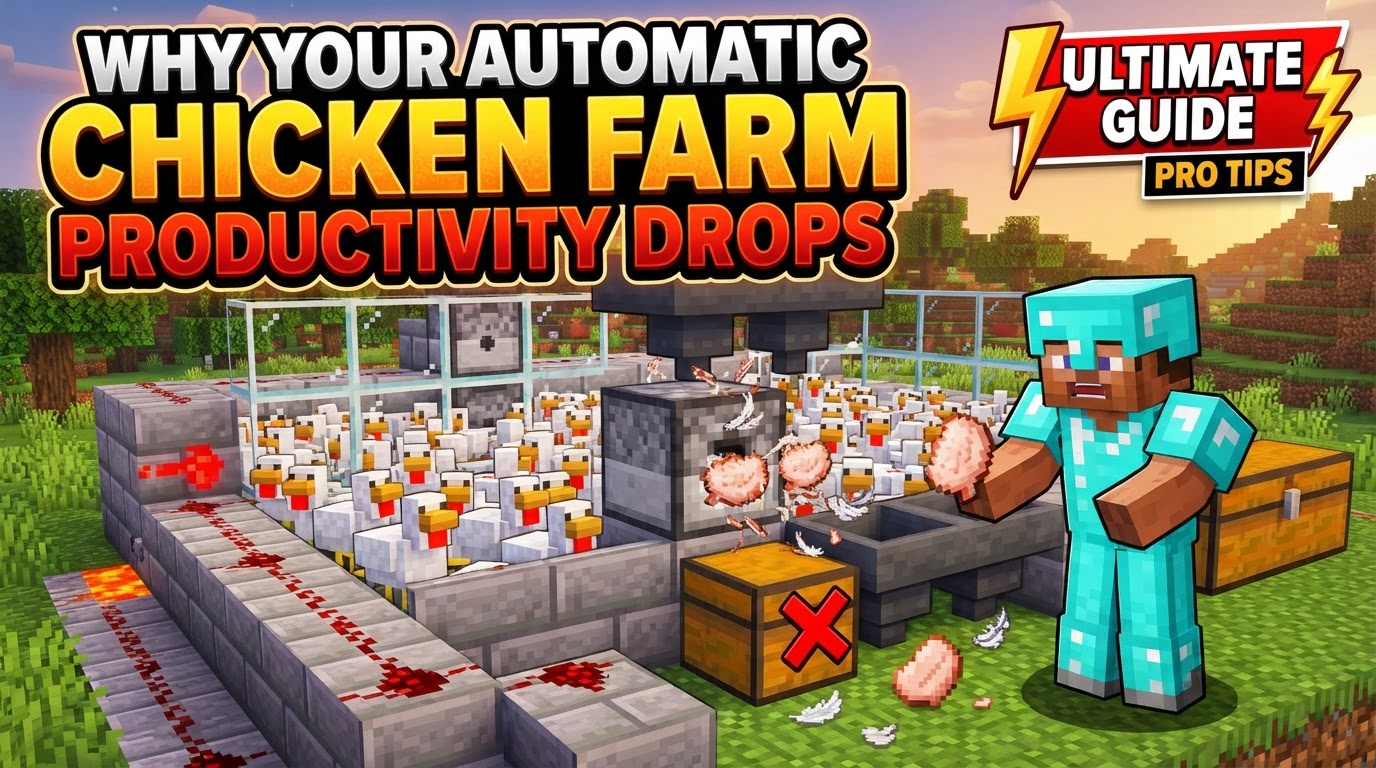
Before diving into what goes wrong, it’s essential to understand how an automatic chicken farm is designed to function. The core concept revolves around a self-sustaining cycle of egg production, hatching, growth, and collection. Adult chickens, housed in a confined area, periodically lay eggs. These eggs are collected by a series of hoppers and fed into a dispenser. The dispenser then “throws” these eggs into a designated chamber. Each thrown egg has a chance to hatch into a baby chick. These chicks grow into adult chickens. Once they reach adult size, they are typically funneled into a killing mechanism, often involving lava, which cooks them instantly. Their drops-cooked chicken and feathers-are then collected by hoppers and deposited into a storage chest. This continuous loop ensures that as long as the farm remains in a loaded chunk, it should theoretically provide an endless supply of resources.
A typical, modern automatic chicken farm design follows a general process:
- A collection chest is placed at the base.
- Hoppers feed into this chest to gather items.
- A key component, often a stonecutter, is placed on top of a hopper. This acts as the platform where adult chickens are killed.
- A dispenser is positioned to face the stonecutter, responsible for launching eggs.
- Above the dispenser, another hopper (or a line of hoppers) collects eggs from the egg-laying chickens.
- A containment area is built above these hoppers to house the adult egg-laying chickens, often lured in with seeds or by throwing eggs.
- A redstone clock or an observer is set up to repeatedly activate the dispenser, throwing eggs into the chamber below.
- A lava source, frequently contained within a cauldron, is placed above the area where chicks hatch and grow. This ensures that when grown chickens come into contact with the lava, they are killed and their drops are cooked.
The Silent Saboteurs: Why Your Farm’s Output Plummets
Despite their elegant design, automatic chicken farms are susceptible to several issues that can drastically reduce their efficiency. These problems often stem from specific game mechanics or design oversights.
The Menace of Entity Cramming
One of the most insidious threats to a chicken farm’s productivity is entity cramming. Minecraft has a hard limit on how many entities (mobs, items, etc.) can occupy a single block space before they begin to take suffocation damage and die. For chickens, this threshold is around 24-25 entities. If your egg-laying chamber or the chick-growing area exceeds this number, chickens will start to die off, not from your killing mechanism, but from the game itself. This reduces your adult chicken population, leading to fewer eggs, fewer hatched chicks, and ultimately, a significant drop in overall output. It’s a silent killer that often goes unnoticed until productivity has already taken a nosedive.
Premature Chick Demise
In certain designs or game versions, newly hatched baby chicks can fall victim to the very system designed to produce them. As the dispenser rapidly throws eggs, there’s a chance that subsequent eggs can collide with a newly hatched chick. This collision can sometimes push the tiny chick into the lava killing chamber before it has had a chance to grow into an adult. The result is a lost chicken that never contributed to your cooked meat supply, effectively wasting the egg and reducing the farm’s efficiency.
The Fiery Demise of Loot
A classic problem, particularly with older farm designs, is the burning of collected loot. If the killing mechanism uses open lava and the collection system isn’t perfectly positioned, cooked chicken and feathers can fall directly into the lava and be destroyed before hoppers can pick them up. This was a significant design flaw in many early automatic chicken farms, leading to substantial resource loss. Even with modern designs, improper placement can still lead to items being incinerated.
The Ghost Farm: Unloaded Chunks
Minecraft worlds are divided into “chunks,” 16×16 block sections that only process game mechanics when they are “loaded.” Your automatic chicken farm will only function if the chunk it occupies is loaded into memory. If you venture too far away from your farm, its chunk will unload, and all its processes-egg laying, dispensing, chick growth, and killing-will cease. This is not a design flaw but a fundamental game mechanic. If your farm seems to stop working when you’re exploring or building elsewhere, an unloaded chunk is almost certainly the culprit.
The Curse of Obsolescence: Outdated Designs
Minecraft is an ever-evolving game, with frequent updates that can subtly or drastically alter game mechanics. What worked perfectly in one version might break or become highly inefficient in another. Changes in how mobs interact with blocks (like lava or hitboxes), redstone behavior, or even item physics can render an older farm design obsolete. Updates around 1.20 and 1.21.10, for example, have specifically impacted chicken farm functionality. Relying on an outdated tutorial for your current game version can lead to unexpected productivity drops.
The Redstone Riddle: Incorrect Wiring
The redstone mechanism is the brain of your automatic farm, controlling the dispenser’s firing rate. An improperly configured redstone clock or observer setup can lead to the dispenser not firing eggs at all, firing too slowly, or firing too rapidly, potentially contributing to premature chick deaths or entity cramming if the system can’t keep up. Even a single misplaced redstone dust or an incorrectly oriented observer can halt the entire operation.
Reclaiming Peak Performance: Solutions and Best Practices
Fortunately, most productivity drops can be addressed with careful design and a solid understanding of game mechanics.
Finding the Sweet Spot: Optimal Chicken Population
To prevent entity cramming, aim for an optimal chicken count. Maintain around 24 adult chickens in your egg-laying area. This number provides peak efficiency for egg production without triggering the entity cramming limit. Regularly check your farm and cull excess chickens if necessary, or design your farm to naturally maintain this balance.
Modern Kill Chambers: Stonecutters and Lava Cauldrons
To combat premature chick deaths and loot burning, modern designs often utilize a stonecutter with a lava-filled cauldron above it. The stonecutter acts as a solid, non-flammable block that baby chicks can safely stand on. When the chicks grow into adults, their larger hitbox extends upwards, touching the lava in the cauldron. This kills and cooks them, while the stonecutter ensures their drops fall safely onto its surface, where hoppers can collect them without risk of incineration.
Smooth Operations: Preventing Stuck Chickens
Chickens, especially in tight spaces, can sometimes get stuck inside the hoppers that collect their eggs. This reduces their egg-laying efficiency and can contribute to entity cramming in the surrounding blocks. Placing carpets on top of hoppers in the egg-laying area prevents chickens from getting stuck while still allowing eggs to be collected.
Streamlining Collection: Hopper Efficiency
For farms with a very high egg output, a single hopper might not be able to transfer eggs to the dispenser fast enough, leading to backups. To increase the speed of egg collection and transfer, consider using multiple hoppers leading into the main dispenser feed. This parallel processing ensures a smoother flow of eggs to the dispenser, maximizing hatching rates.
Advanced Item Transport: Minecarts with Hoppers
For extremely reliable and high-volume item collection, especially in complex or large-scale setups, a minecart with a hopper can be an excellent addition. Placed on rails underneath the killing area, a minecart with a hopper can collect items faster and from a wider area than stationary hoppers, ensuring minimal loot loss.
Staying Ahead of the Curve: Version Compatibility
The best defense against outdated designs is to stay updated. Always consult tutorials and guides specifically tailored for your current Minecraft version (Java or Bedrock Edition) to ensure compatibility with present game mechanics. A quick search for “Minecraft [Your Version] automatic chicken farm” will yield the most relevant and reliable designs.
An automatic chicken farm, when properly designed and maintained, is an incredibly efficient system. By understanding the common pitfalls like entity cramming, loot burning, and the impact of game updates, you can troubleshoot existing farms or build new ones that reliably churn out cooked chicken and feathers, freeing you to focus on other adventures in your Minecraft world.
Tags:
YOU MAY ALSO LIKE...