Why Your Automatic Potion System Sometimes Creates Duplicates
Your automatic potion system isn’t truly duplicating items in the traditional sense of creating something from nothing. More often than not, when players observe their meticulously crafted contraptions churning out “duplicates,” they are witnessing one of two distinct scenarios: either a functional malfunction leading to unintended repeated brewing of the same potion, or they are encountering a known game glitch designed for item duplication, entirely separate from the automated brewing process itself. Understanding this fundamental distinction is the first step in diagnosing and rectifying the issue.
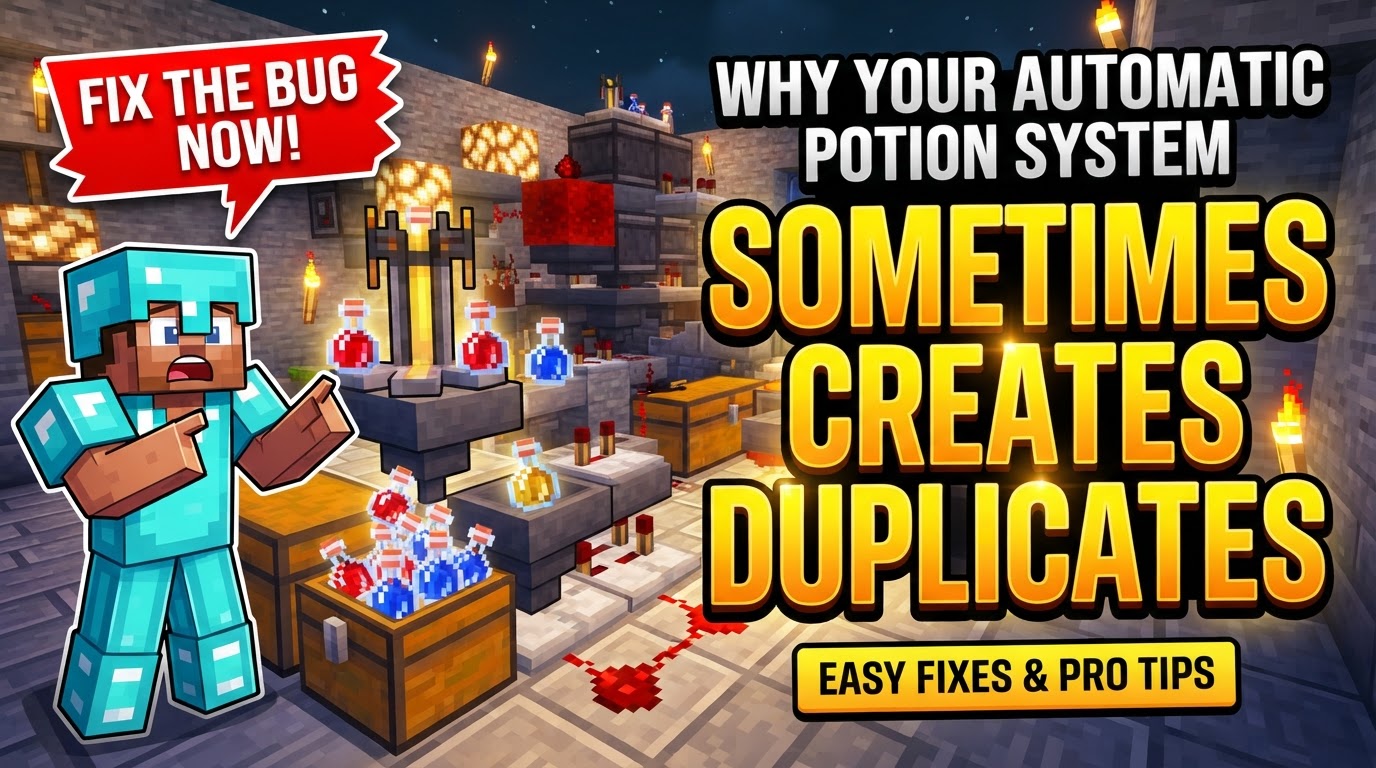
Standard automatic brewing systems are engineered to streamline the tedious process of potion crafting, to deliver efficiency and consistency, not to generate infinite resources. When your system seems to be stuck in a loop, producing multiple copies of an intermediate or final potion, it’s typically a sign that the intricate dance of redstone and hoppers has fallen out of sync. Let’s delve into the mechanics to uncover why this happens and how to prevent it.
The Building Blocks of Potion Automation
At the heart of any automatic potion system lies a combination of key Minecraft blocks, each playing a vital role in the seamless production of brews. A firm grasp of their functions is essential to troubleshoot any system anomalies.
- Brewing Stand: This is the central processing unit. It requires blaze powder as fuel, which allows it to convert ingredients into potions. The bottom three slots are designated for water bottles or uncraftable potions (like Awkward Potions), while the single top slot is for the brewing ingredient.
- Hoppers: These versatile blocks are the arteries of your system, facilitating item movement. Hoppers feed ingredients into the top of the brewing stand and collect finished potions from the bottom. Crucially, hoppers can be locked by a powered redstone signal, preventing any item movement through them. This locking mechanism is paramount for precise timing in automation.
- Droppers/Dispensers: Used for the controlled delivery of items. Droppers are typically employed to push specific ingredients or water bottles into hoppers that then feed the brewing stand. Unlike dispensers, droppers simply place the item into the inventory they face or drop it as an item entity.
- Redstone Circuitry: This is the “brain” of the operation. Redstone dust, comparators, repeaters, and observers work in concert to manage the timing of ingredient delivery, brewing cycles, and potion collection. They activate or deactivate hoppers and droppers at precise moments, dictating the flow of items and the progression of the brewing process.
An Ideal Brewing Symphony: How Automation Should Work
A perfectly functioning automatic potion system executes a precise sequence of actions to transform raw ingredients into desired potions. This step-by-step process ensures a smooth, predictable output without any unintended repetition.
- Initial Loading: Water bottles or initial potions (like Awkward Potions) are fed into the brewing stand’s lower slots, typically via hoppers.
- First Ingredient Delivery: The first brewing ingredient (e.g., Nether Wart for Awkward Potions) is delivered to the brewing stand’s top slot, usually by a dropper feeding into a hopper, which in turn feeds the brewing stand.
- Brewing Cycle: The brewing stand processes the ingredients. This takes a fixed amount of time.
- Potion Collection: Once brewed, the resulting potions are collected by a hopper positioned directly underneath the brewing stand. This hopper typically moves the potions to a storage unit or to the next stage of the brewing process.
- Next Ingredient Delivery: If the potion requires further refinement (e.g., adding Redstone Dust for extended duration or Glowstone Dust for amplified effect), new ingredients are delivered to the top slot of the brewing stand.
- Repetition and Completion: The process repeats with subsequent ingredients until the final desired potion is created. At this point, the completed potions are usually moved to a final output chest or further processing.
This sequence relies on accurate redstone timing to ensure each step completes before the next begins, and that ingredients are delivered only when needed, and only once per brewing stage.
The Glitches in the Machine: Why Your System Repeats Brews
When your automatic potion system appears to be creating “duplicates” – meaning it’s repeatedly brewing the same potion type when it should have moved on or stopped – it’s almost always due to a malfunction in the system’s design or execution. These are not true item duplications but rather inefficiencies or errors in the automation logic.
The Redstone Rhapsody Gone Wrong
Redstone is the conductor of your brewing orchestra, and even a slight mistiming can throw the entire performance into disarray. If redstone signals are mistimed, several issues can arise:
- Premature Activation: A signal might activate a dropper too early, pushing an ingredient into the brewing stand before the previous brew has finished or before the current ingredient has been collected. This can lead to the brewing stand re-brewing with the same ingredient if the previous one wasn’t removed.
- Delayed Deactivation: If a redstone signal meant to lock a hopper is released too late, or a signal to activate a dropper is too short, ingredients might not be delivered or collected efficiently. Conversely, if a signal meant to unlock a hopper is too short, potions might not be fully extracted.
- Incorrect Cycling: The redstone logic responsible for cycling through different ingredients might be flawed. For example, if a comparator isn’t correctly detecting an empty brewing stand or a specific item count, it might repeatedly trigger the delivery of the same ingredient, leading to an overproduction of that specific potion type.
These timing errors result in the system getting stuck, repeatedly performing the same brewing action instead of progressing to the next stage or shutting down.
Hoppers: The Bottlenecks and Misdirections
Hoppers are simple yet powerful blocks, but their precise control is crucial. Malfunctions here can severely impact your system’s flow:
- Improper Locking/Unlocking: If hoppers aren’t locked or unlocked correctly by redstone, they can cause havoc. An output hopper that fails to unlock and extract potions will cause them to accumulate in the brewing stand, preventing new brewing cycles from starting. Conversely, an input hopper that is never locked might continuously feed ingredients, leading to repeated brews if the brewing stand isn’t emptying properly.
- Clogged Output: If the output hopper leading from the brewing stand becomes full or is improperly connected to storage, it can back up the entire system. Potions will remain in the brewing stand, and if the input mechanism continues to deliver ingredients (due to flawed redstone logic), the stand will repeatedly brew the same potion until the backlog is cleared.
- Ingredient Mismatch: An improperly timed or unlocked hopper could pull an ingredient from an incorrect slot or deliver it at the wrong time, leading to the brewing stand processing the wrong item or re-processing an item that should have been replaced.
Ingredient Input: A Recipe for Repetition
The management of ingredients is paramount. Errors in this area often lead to the system getting stuck on one specific potion type:
- Flawed Cycling Logic: The system’s logic for cycling through different ingredients or for knowing when to stop can be faulty. If the mechanism designed to deliver “Ingredient A” then “Ingredient B” then “Ingredient C” fails to advance past “Ingredient A,” the brewing stand will continually receive “Ingredient A,” resulting in a continuous stream of the same potion.
- Continuous Supply: If a dropper or hopper is constantly feeding the same ingredient without a mechanism to stop or change it, the brewing stand will naturally keep brewing with that ingredient as long as there are base potions available. This is a common oversight in simpler designs that don’t account for ingredient depletion or stage progression.
Output Overload: The Unmoving Potions
Even if the brewing process itself is flawless, issues with handling the finished product can create the illusion of duplicates:
- Inefficient Collection: If brewed potions are not efficiently moved out of the system, they can accumulate in the brewing stand’s output slots. This prevents new brewing cycles from starting or, if the input remains active, leads to a backlog of identical potions that can’t be cleared.
- Insufficient Storage: A full output chest or an improperly routed collection system can cause potions to pile up. While not strictly “duplicates” being brewed, it appears as an overabundance of the same potion, mimicking the effect of unintended repeated brewing.
Beyond Automation: True Potion Duplication Glitches
It’s important to distinguish the above malfunctions from genuine item duplication glitches. These glitches are exploits of game mechanics, often specific to certain Minecraft editions (like Bedrock Edition) or versions, and are an intentional method for players to gain infinite items, not a design flaw of an automated brewing process.
A prominent example of a true potion duplication glitch involves the use of pointed dripstone above a cauldron filled with a potion. In specific circumstances, as water drips from the dripstone into the cauldron, the cauldron can sometimes refill with the potion itself, rather than water. This allows players to collect multiple bottles of the same potion from a single source, effectively creating duplicates. This method bypasses the brewing stand entirely and is a known exploit, completely separate from the challenges of designing a reliable automatic brewing system.
Distinguishing Malfunction from Exploit
In conclusion, when your automatic potion system produces what appears to be “duplicates,” the cause is almost certainly a design flaw or timing error within your redstone and hopper configuration. Carefully review your redstone timings, ensure hoppers are locking and unlocking precisely, and verify your ingredient management logic. These systems are designed to automate, not to duplicate. True potion duplication is a rare and often version-specific glitch that exploits fundamental game mechanics, standing apart from the intricate, yet fallible, world of automated brewing.
Tags:
YOU MAY ALSO LIKE...