Calculating Knockback Distance From Enchantments, Explained
Understanding Knockback in Minecraft
Knockback is a pivotal enchantment in Minecraft, primarily enhancing offensive capabilities by increasing the distance enemies are pushed back upon being struck. This guide delves into the intricate mechanics of how knockback distance is calculated, taking into account enchantments, player actions, and mob resistances. While exclusive to swords, an equivalent enchantment known as Punch exists for bows, serving a similar function in ranged combat. Mastering the calculation and application of knockback can provide a significant advantage in various in-game scenarios, from managing hostile mobs to strategic player-versus-player engagements.
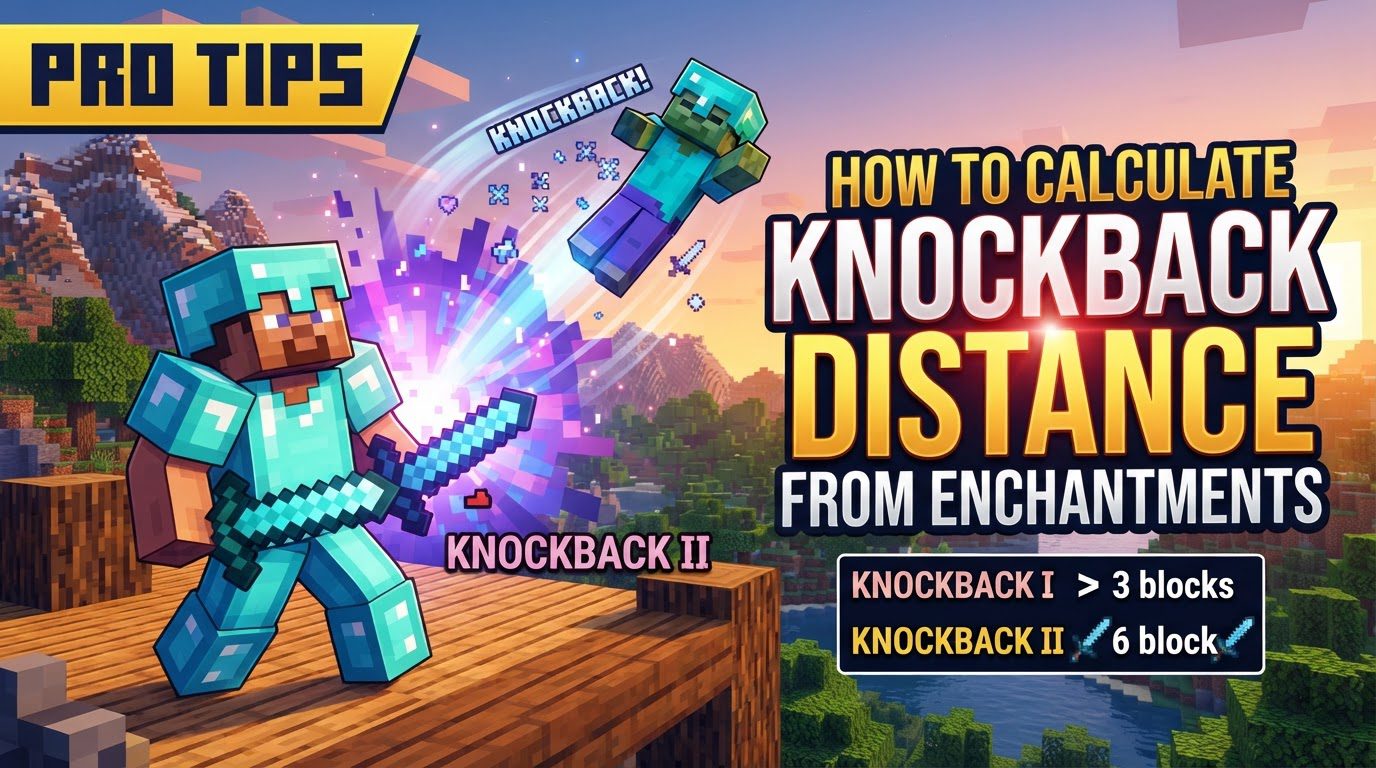
The core function of the Knockback enchantment is to amplify the natural pushback of an attack. This effect is not limited to horizontal movement across the X and Z coordinates but also extends to vertical displacement along the Y coordinate, meaning targets can be pushed both backward and upward. However, it’s crucial to recognize that not all entities react uniformly to knockback. Certain mobs exhibit resistance or even complete immunity, adding layers of complexity to its application.
Key Mechanics of Knockback Enchantment
To accurately calculate the knockback distance, one must first understand the fundamental mechanics at play. The enchantment directly modifies the base knockback of an attack, with different levels providing distinct multipliers:
- Knockback I: This level increases the base knockback by 105%. This means the initial knockback value is effectively multiplied by 1.05.
- Knockback II: A more potent version, Knockback II increases the base knockback by 190%. Consequently, the base knockback is multiplied by 1.90.
Beyond the enchantment itself, several other factors contribute to the initial knockback an entity receives:
- Sprinting Attack: When an attacker is sprinting while striking a target, a natural increase in knockback is applied. This additional force combines with the enchantment’s effect, contributing to the initial base knockback value before further modifications.
- Mob Resistances and Immunities: Not all creatures respond to knockback in the same way.
- Wardens: These formidable creatures are completely unaffected by any form of knockback.
- Iron Golems: While Iron Golems are resistant to knockback from normal attacks, they are still affected by the additional knockback provided by the enchantment.
- Squids: These aquatic mobs demonstrate resistance to knockback when they are out of water.
- Player-Specific Modifiers: In certain situations, the knockback received by players can be altered:
- Damaged Players in Air: Players who are already damaged and airborne will receive less knockback. This can influence the flow of combat, particularly in aerial engagements.
- PvP Forward Movement: In player-versus-player combat, if the attacker is moving forward at the moment of impact, the horizontal knockback received by the defender is reduced. Specifically, the horizontal knockback is multiplied by 0.6, effectively reducing it by 40%. This mechanic can make it harder for an attacker to maintain a combo or distance an opponent if they are aggressively pushing forward.
Step-by-Step Calculation Process
Calculating the final knockback distance involves a sequential application of these mechanics. Here’s the process:
- Step 1: Determine the Base Knockback.
The initial knockback value of an attack is established first. This base value incorporates factors such as whether the attacker was sprinting during the strike. A sprinting attack naturally provides a greater base knockback than a static one.
- Step 2: Apply Enchantment Multipliers.
Once the base knockback is determined, the enchantment’s effect is applied as a direct multiplier. For Knockback I, the base knockback is multiplied by 1.05. For Knockback II, it is multiplied by 1.90. This step significantly amplifies the initial pushback, forming the enchanted knockback value.
- Step 3: Apply Further Modifiers.
After the enchantment’s effect has been calculated, any additional situational modifiers are applied to this amplified value. These modifiers include:
- PvP Forward Movement: If the attacker is moving forward in PvP, the horizontal component of the knockback (already modified by the enchantment) will be multiplied by 0.6. This reduces the horizontal distance the opponent is pushed back.
- Mob Resistances: If the target is a mob with specific resistances (e.g., Iron Golems from normal attacks, Squids out of water), these resistances will reduce the final knockback distance. For immune mobs like Wardens, the knockback effectively becomes zero at this stage.
- Damaged Players in Air: If the target is a damaged player already in the air, the final knockback they receive will be reduced.
The result of these sequential calculations is the final knockback distance the target will travel.
Important Tips for Utilizing Knockback
Understanding the calculation is only one part; effectively using knockback requires strategic application:
- Crowd Control and Defense: Knockback is highly effective for creating crucial distance from hostile melee mobs. For instance, using it against Creepers can prevent them from reaching you and detonating prematurely, saving you from damage and environmental destruction.
- Environmental Hazards: Offensively, knockback can be used to push mobs off ledges, into pits, or directly into environmental hazards such as lava or cacti, providing an efficient way to dispatch groups or powerful individual enemies without direct engagement.
- Acquiring the Enchantment: The Knockback enchantment can be obtained through various in-game methods:
- Enchantment Table: By enchanting swords at an enchantment table.
- Fishing: With luck, enchanted books can be fished up.
- Structure Chests: Enchanted books, including Knockback, can be found in chests within various generated structures.
- Villager Trading: Librarian villagers may offer enchanted books in exchange for emeralds.
- Enhancing Enchantment Chances: When using an enchantment table, surrounding it with bookshelves can increase the likelihood of generating higher-level enchantments, including Knockback II.
- Command-Based Levels: While typically capped at level II through normal gameplay, Java Edition players can use game commands to apply higher levels of Knockback. This can result in exaggerated and often comical effects, pushing entities immense distances.
Common Mistakes to Avoid
Despite its utility, misusing Knockback can lead to undesirable outcomes:
- Ineffectiveness Against Ranged Enemies: Using Knockback against ranged foes like Skeletons can be disadvantageous. Pushing them further away makes it harder to close the distance and engage them in melee, while they continue to fire arrows at you from afar.
- Scattered Loot: While effective for crowd control, excessive knockback can scatter mob drops over a wide area. This can make collecting loot cumbersome and time-consuming, especially after defeating multiple enemies.
- Assuming Universal Response: A critical mistake is assuming all mobs respond identically to knockback. Always remember that some mobs, like Wardens, are entirely unaffected, while others, such as Iron Golems, have specific resistances.
- Incorrect Item Application: Knockback is a sword-exclusive enchantment (Punch for bows). Attempting to apply it to other items without using commands will not work, as it is designed for specific weapon types.
- PvP Follow-up Issues: In player-versus-player combat, applying too much knockback can sometimes be detrimental. Pushing opponents too far away can prevent follow-up attacks, breaking combos, and allowing them to recover or escape. This is particularly relevant when considering the 40% reduction in horizontal knockback if the attacker is moving forward, as it implies a trade-off between aggressive movement and maximizing pushback.