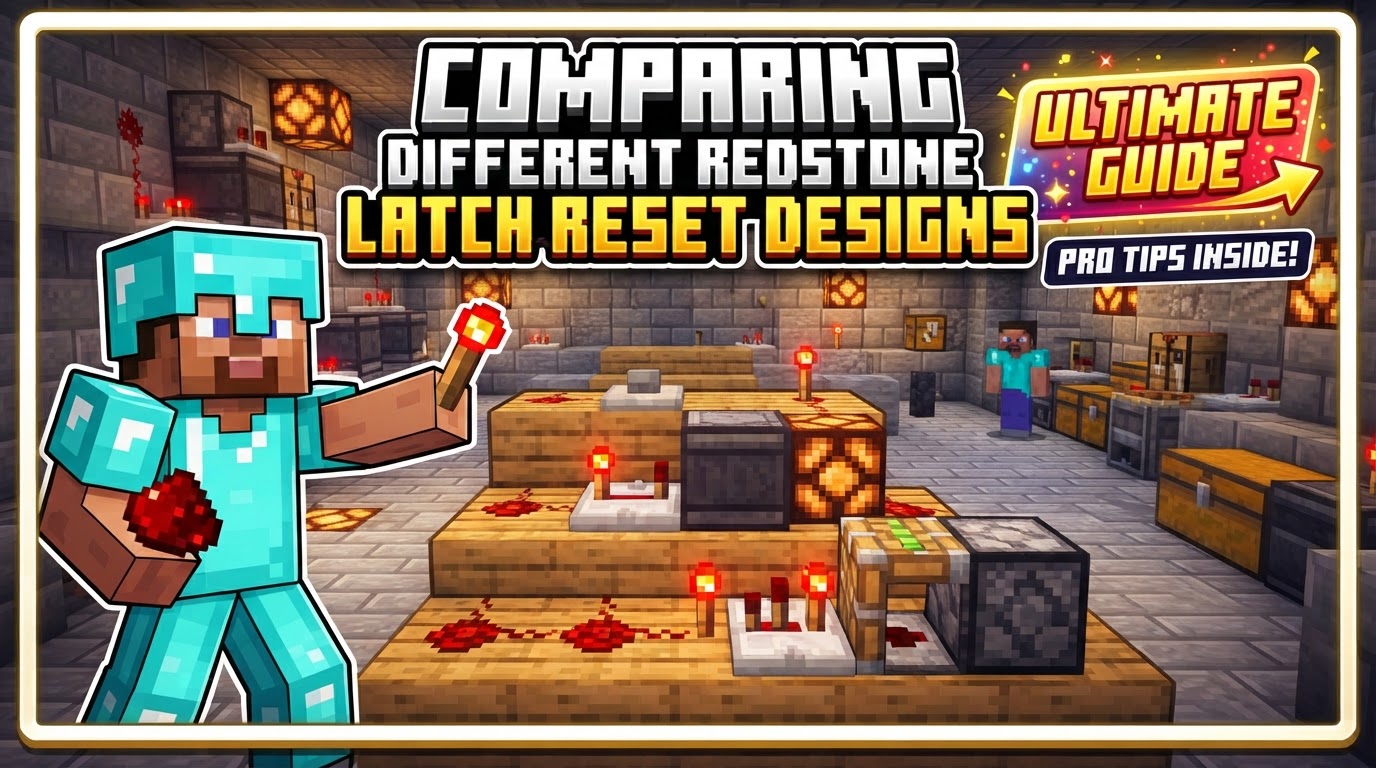
Comparing Different Redstone Latch Reset Designs
Activating both the ‘Set’ and ‘Reset’ inputs on an RS latch simultaneously can result in an unstable or “freaking out” state, a common pitfall for redstone engineers. Understanding how to properly reset your redstone latches is paramount to building reliable and predictable circuits in Minecraft. Latches are the memory cells of redstone, capable of retaining an ‘on’ or ‘off’ state until deliberately changed, effectively transforming a fleeting button press into a continuous output like a perpetually lit lamp. While all latches store information, their methods for clearing or resetting that stored state vary significantly between designs, each offering unique advantages and challenges for your builds.
The Foundational Memory: RS (Set-Reset) Latches
At the heart of many complex redstone contraptions lies the RS (Set-Reset) latch. These fundamental components are characterized by distinct ‘Set’ (S) and ‘Reset’ (R) inputs. When the ‘Set’ input is activated, the latch turns ON and stays ON, even after the ‘Set’ signal is removed. Conversely, activating the ‘Reset’ input forces the latch OFF, maintaining that state until ‘Set’ is triggered again. This persistent output makes RS latches ideal for scenarios where a momentary action needs to produce a continuous effect.
Many RS latch designs, most notably the RS-NOR latch, are designed with dual outputs, often labeled ‘Q’ and ‘Q-bar’. These outputs are always inverse to each other; if ‘Q’ is ON, ‘Q-bar’ is OFF, and vice-versa. This characteristic is incredibly useful for controlling complementary systems. The RS-NOR latch, typically constructed with redstone torches, is a classic and foundational design due to its simplicity and effectiveness.
Constructing a Basic RS-NOR Latch
Building an RS-NOR latch is a straightforward process, making it an excellent starting point for understanding latch mechanics:
- Place two solid blocks adjacent to each other, leaving a one-block gap between them.
- On the sides of these blocks facing the gap, place redstone torches. These torches should be powered by the blocks they are on.
- Connect redstone dust to the outputs of these torches. The dust from one torch’s output should lead into the block supporting the *other* torch, creating a cross-feedback loop.
- Designate one input line as ‘Set’ and the other as ‘Reset’. These inputs typically power or unpower the blocks the torches are on, or the redstone dust connected to them, to switch the torch states. For instance, powering the block supporting a torch will turn that torch off.
- A common compact design for an RS-NOR latch can be achieved within a 2×5 block footprint, though variations exist.
The Dynamic State Changer: T (Toggle) Flip-Flops
In contrast to the dual-input RS latch, T (Toggle) flip-flops operate with a single ‘Toggle’ input. Each activation of this input, typically an OFF-to-ON signal transition, reverses the current state of the latch. If the T flip-flop is ON, it switches OFF; if it’s OFF, it switches ON. This makes them perfect for simple on/off switches that cycle with each press, like a light switch that toggles with a single button.
While T flip-flops excel at toggling, they do not inherently possess a dedicated reset input like RS latches. For scenarios where you need to force a T flip-flop into a specific state (e.g., ensuring it’s OFF before a sequence begins), an additional circuit is required. This separate reset mechanism is crucial for maintaining control in more complex systems.
Tailored Resetting Strategies for Your Latches
The method you employ to reset a latch will largely depend on its type and the scale of your redstone system.
Resetting Multiple RS Latches
When dealing with an array of RS latches, such as in a memory bank or a programmable door lock, a common reset line is an efficient solution. This involves:
- Connecting a single redstone line that branches out to the ‘Reset’ input of each individual RS latch.
- Utilizing redstone repeaters along this common reset line. Repeaters are essential to ensure the signal remains strong enough to reach and power every latch’s reset input, preventing signal decay over distance. They also provide directionality and signal delay.
- Depending on the specific setup and desired timing, these repeaters can reset latches either simultaneously or in a carefully timed sequence.
Integrating a Reset into T Flip-Flops
Since T flip-flops lack a built-in reset input, forcing them into a default state requires a dedicated addition:
- Integrate a separate reset mechanism directly into the T flip-flop circuit. This often involves a bypass or override circuit.
- This typically routes a dedicated reset signal that can force the T flip-flop into its “off” state. A common approach involves using an AND gate. The AND gate controls the flip-flop’s output, allowing it to be ON only if both the flip-flop’s internal state is ON and the reset signal is inactive. If the reset signal becomes active, the AND gate forces the output OFF, regardless of the flip-flop’s internal state.
Optimizing Your Designs: Tips for Success
Effective redstone engineering involves not just building circuits, but understanding their optimal application and potential pitfalls.
- Purposeful Application: Employ latches when a momentary signal needs to produce a continuous output, such as turning a button press into a persistent light switch or opening a door that stays open until manually closed.
- Automated Reset: An RS latch can be made to automatically reset after a set duration. This is achieved by routing its output through a series of redstone repeaters (set to appropriate delays) back to its own ‘Reset’ input. Once the output goes ON, the delayed signal eventually triggers the ‘Reset’, turning the latch OFF again.
- System Integration: RS latches are particularly effective for building systems that require values to be stored and then entirely cleared, such as the aforementioned programmable door locks, combination safes, or even basic calculators.
- Pulse Length for T Flip-Flops: Some T flip-flop designs are sensitive to the length of the input pulse. For instance, a wooden button’s longer pulse (1.5 seconds) might necessitate adjusting repeater delays within the T flip-flop to ensure proper toggling without accidental double-toggles or missed states. Stone buttons provide a shorter pulse (1 second).
- Compactness: Redstone torch-based RS latches are generally quite compact. Similarly, many modern T flip-flop designs are also small and can be built piston-less, minimizing complexity and resource usage.
Avoiding Pitfalls: Common Redstone Latch Mistakes
Even seasoned redstone engineers can fall victim to common errors. Awareness is your best defense:
- Simultaneous Set and Reset (RS Latches): As mentioned, activating both the ‘Set’ and ‘Reset’ inputs on an RS latch simultaneously can lead to an unstable or “freaking out” state where the outputs rapidly flicker, or settle into an unpredictable state. Always design your inputs to be mutually exclusive.
- Signal Decay: Redstone signals weaken and die after 15 blocks. Always use redstone repeaters to extend signals, especially when designing long reset lines for multiple latches. Failure to do so will result in only the nearest latches receiving the reset signal.
- Incorrect Block Placement: Ensure redstone dust is placed on solid, full blocks for reliable signal transmission. Transparent blocks like glass, stairs, or slabs can interfere with or entirely block redstone signals, leading to unexpected behavior.
- Version Incompatibility: Be aware that redstone mechanics can vary significantly between Minecraft’s Java and Bedrock editions. For example, Java Edition features ‘quasi-connectivity’ (budding), which is absent in Bedrock. Always check tutorials for version compatibility and be prepared to adapt designs for your specific game version.
- Block Update Detectors (BUD) Issues: When dealing with components like droppers or pistons that are part of a reset circuit, avoid placing solid blocks directly above them that might trigger unintended block updates (BUDs). Using non-solid blocks like slabs or glass in such positions can often prevent these issues.
- Flawed T Latch Designs: Some older or overly simplistic T latch designs may continuously toggle if the trigger input is held ON for too long. Robust designs should function correctly regardless of the input’s duration, typically by detecting a signal edge (rising or falling) rather than a continuous ON state.
Mastering the art of redstone latch reset designs is a crucial step in becoming a proficient Minecraft redstone engineer. By understanding the distinct characteristics of RS latches and T flip-flops, and by employing the correct resetting strategies while avoiding common pitfalls, you can build more reliable, efficient, and sophisticated contraptions in your Minecraft worlds.
Tags:
YOU MAY ALSO LIKE...