How to Build a Working Factory in Minecraft
One of the most common misconceptions new players have about building a factory in Minecraft is that it requires incredibly complex, advanced Redstone knowledge from the outset. While sophisticated automation does leverage intricate Redstone, the core principles of a working factory are surprisingly accessible, revolving around automating basic processes like resource gathering, crafting, and item transportation. A Minecraft factory isn’t just about building a structure; it’s about engineering a system that works for you, transforming raw materials into finished goods with minimal manual intervention.
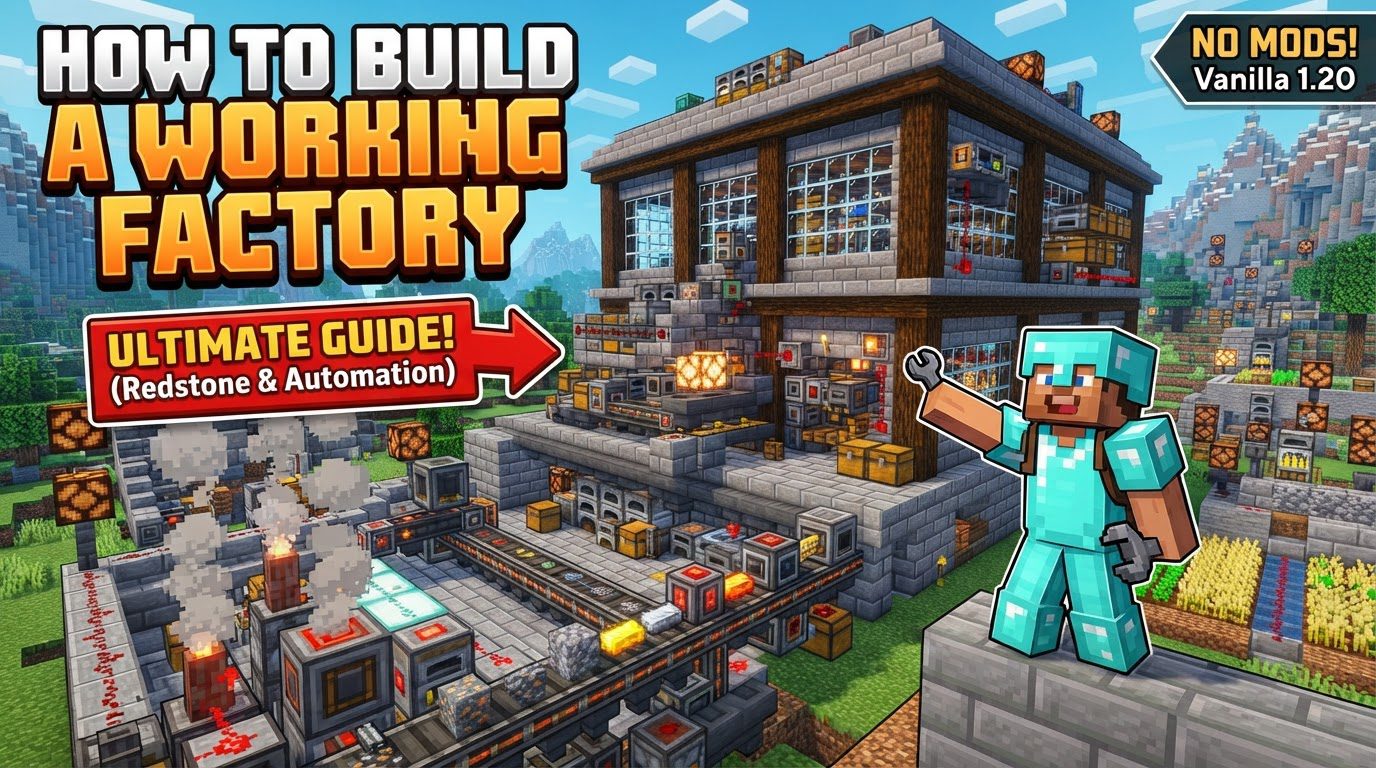
At its heart, a working factory in Minecraft is a series of interconnected, automated systems designed to perform specific tasks. This involves carefully orchestrating the movement of items, the activation of machines, and the storage of products. The beauty of these systems lies in their modularity and the endless possibilities for expansion, allowing you to scale from a simple automated smelter to a sprawling complex producing advanced components.
The Foundational Mechanics of Automation
To build any successful automated system in Minecraft, you must first understand its foundational mechanics. These are the building blocks upon which all factories are constructed.
- Redstone Automation: The lifeblood of any automated system. Redstone dust acts as wiring, transmitting signals. Repeaters extend signals and control timing, while comparators detect container fullness or compare signal strengths, crucial for precise logic. Observers detect block updates, triggering actions, and pistons move blocks, often used in farms or item sorting. “Clock” circuits, frequently built with repeaters, provide continuous, timed pulses, essential for automating devices like Crafters.
- Item Transportation: Moving items efficiently is paramount. Hoppers are the workhorses, transferring items between containers and machines. For longer distances or bulk transport, Minecarts, especially hopper minecarts running on rails, are highly effective, capable of moving large quantities of items across significant distances.
- Automated Crafting: The introduction of the Crafter block revolutionized automated production. This block allows for automated crafting of any recipe. It functions by receiving items from hoppers and requiring a Redstone signal to activate, producing the crafted item.
- Storage Systems: An efficient factory needs robust storage. Chests and barrels are standard containers. For compact, portable storage, Shulker Boxes are invaluable, especially when integrated with hoppers for automatic sorting and input/output, ensuring finished products are neatly organized.
Strategic Planning for Your Production Line
Before placing a single block, strategic planning is key. A well-thought-out design saves time and resources, preventing costly rebuilds down the line.
The very first step is to define your goal. What do you want your factory to produce? Is it a simple automated furnace for smelting raw ore, a complex system for crafting specific Redstone components, or a large-scale farm for a particular resource? Clearly articulating your objective will dictate the scale, complexity, and specific components required for your factory.
Next, it’s crucial to plan your layout. Consider the flow of items from raw input to finished output. Where will materials enter? Where will they be processed? How will they move between stages? And where will the final products be stored? Think about spatial efficiency; factories that use space well are not only more aesthetically pleasing but also often more functional. A common and effective strategy is to build around your core machines. Place your furnaces, Crafters, or other processing units first, and then design the surrounding structure and automation (hoppering, Redstone wiring) around them. Utilizing multi-layer floors can be incredibly beneficial for concealing Redstone wiring and item pipes, leading to a much cleaner and more organized aesthetic.
Building Your Factory: A Step-by-Step Approach
With your plan in mind, you can begin constructing your factory following a general automation pipeline.
Establishing Resource Input
Every factory needs raw materials. Set up a reliable system to feed these materials into your factory. This might involve direct integration with automatic farms (e.g., for crops or mob drops), sophisticated sorting systems that filter items from a mining operation, or even a simple bank of chests where you manually deposit items to kickstart the process. The goal is a consistent and sufficient supply of inputs.
Integrating Processing Units
This is where the transformation happens. Integrate your chosen machines like furnaces for smelting ores or food, or Crafters for assembling more complex items. Ensure these units are correctly positioned to receive their necessary inputs from your resource input system. For furnaces, this means hoppers feeding raw materials into the top and fuel into the side. For Crafters, it means hoppers feeding specific ingredients into their inventory slots.
Managing Item Flow
Once processing begins, items need to move to the next stage. Use hoppers extensively to transport items from input chests to processing units, from processing units to further processing, or directly to output. Droppers and dispensers can be used for upward item transport or to launch items into collection systems. For very complex setups or when items need to travel long distances, minecarts on rails are indispensable, offering high-volume, long-range transportation.
Implementing Redstone Logic
Redstone is the brain of your factory. Design circuits to control the timing and activation of your processing units. This includes providing the necessary Redstone signals to power Crafters, controlling the flow of items through hopper lines (e.g., locking hoppers until specific conditions are met), and creating “clock” circuits to ensure continuous, timed operation of automated processes. Understanding basic Redstone gates and signal propagation is crucial here.
Output and Centralized Storage
Finally, create a robust system to collect all finished products. This usually involves a series of hoppers leading from the final processing stage to a centralized storage area. This storage area can be a simple array of chests or a more advanced sorting system that automatically categorizes different finished goods into their respective containers. The aim is to ensure products are easily accessible and organized.
Optimizing Your Factory and Avoiding Pitfalls
Building a factory is an iterative process. Understanding common mistakes and implementing best practices will significantly improve your factory’s efficiency and reliability.
Smart Layout and Modular Design
As mentioned, plan your layout carefully. A clean, logical arrangement prevents clogs and simplifies troubleshooting. Adopt a modular design approach; build your factory in distinct sections that can function independently or be easily connected. This makes it easier to expand your factory in the future or pinpoint issues in a specific module without affecting the entire system.
Efficiency and Filtering
To prevent items from mixing or systems from clogging, utilize filters. Simple hopper filter designs can ensure that only specific items enter a processing line, while others are diverted. This is vital for complex factories producing multiple items. Efficient space usage also contributes to a cleaner, more manageable factory. Don’t just build big; build smart, making every block count.
Addressing Bottlenecks and Overloads
One of the most common issues is a bottleneck. This occurs when the input of raw materials is insufficient for the processing units, or item transportation is too slow. Monitor your factory’s throughput and identify any points where items accumulate or processes stall. Conversely, overloading systems by pushing too many items through too quickly can lead to backups and blockages, especially in transportation lines or storage buffers. Implement buffer chests or slower clock speeds if you notice items getting stuck.
Mastering Redstone Precision
Underestimating Redstone complexity is a frequent mistake. Automated systems often demand precise Redstone timing and logic. Incorrectly built circuits, such as improperly timed clocks or misconfigured comparators, can lead to malfunctions or complete system failure. Test each Redstone component individually before integrating it into a larger system. Debugging Redstone can be challenging, so clear, organized wiring is always a good practice.
Building a working factory in Minecraft is a rewarding endeavor that combines creativity, engineering, and problem-solving. By understanding the core mechanics, planning meticulously, and iteratively refining your designs, you can construct a powerful automated system that significantly enhances your Minecraft experience.
Tags:
YOU MAY ALSO LIKE...