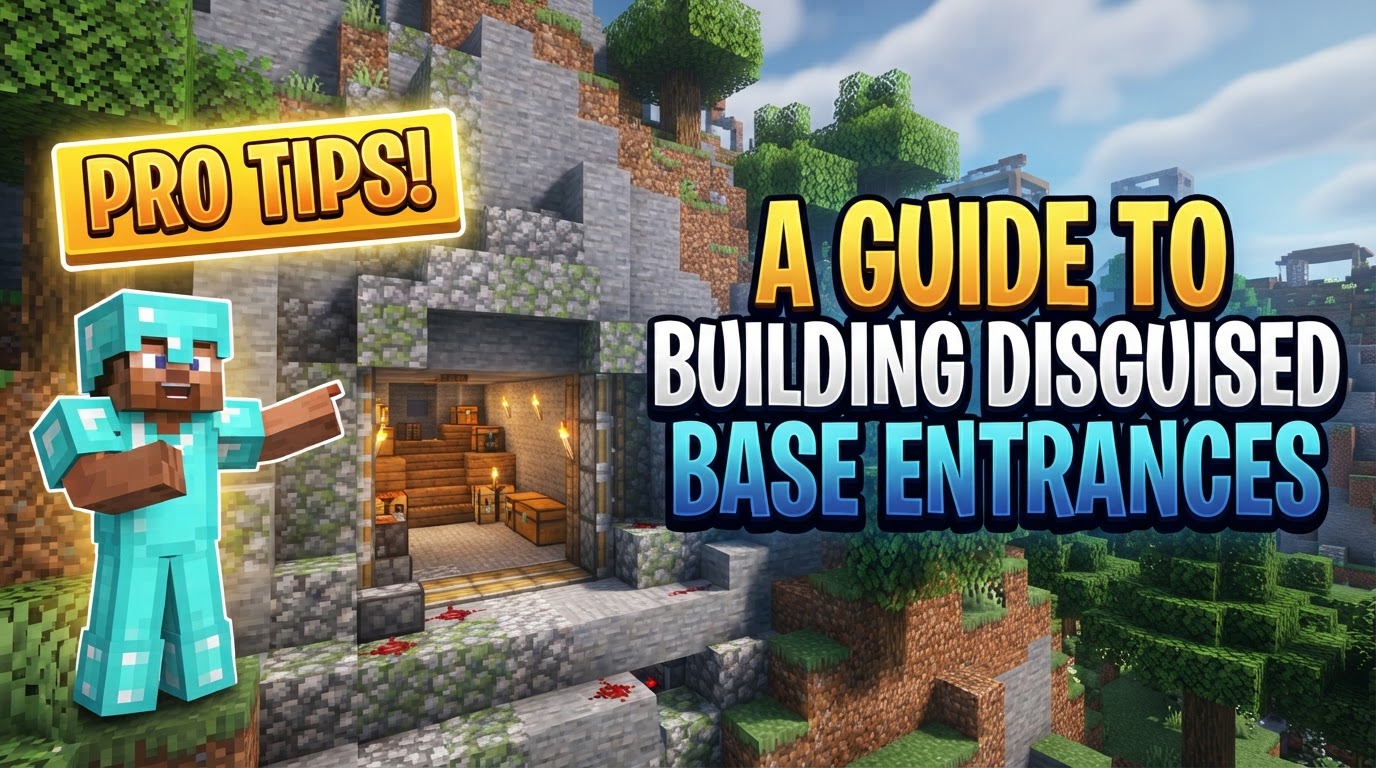
A Guide to Building Disguised Base Entrances
Leaving redstone components exposed is one of the quickest ways to reveal your secret base, instantly compromising the privacy and security you’ve meticulously tried to establish. In the world of Minecraft, where creativity meets survival, the art of building a disguised base entrance is a highly valued skill. Whether for protecting precious belongings on a multiplayer server, creating a private sanctuary, or simply for the sheer fun and challenge of it, a hidden entrance can be absolutely crucial. This guide delves into the mechanics, strategies, and common pitfalls involved in constructing an entrance so secret, even you might occasionally forget where it is.
The Foundations of Secrecy: Key Mechanics and Integration
At the heart of any truly disguised base entrance lies a clever combination of mechanics and environmental integration. These elements work in tandem to transform a visible pathway into an invisible one, or to create an entirely new, hidden route.
- Redstone Automation: The Invisible Hand
The magical dust of redstone, paired with sticky pistons and observers, forms the backbone of automated hidden entrances. These components allow blocks to be moved, pulled, and pushed out of the way, revealing a hidden passage or sealing it off. Many sophisticated designs specifically utilize intricate piston doors, which can retract entire sections of a wall or floor, making them vanish as if by magic. The power of redstone allows for dynamic changes to the environment, making a solid wall appear where a doorway once was, and vice versa. - Trigger Mechanisms: Your Secret Key
The method by which your hidden entrance is activated is just as important as the mechanism itself. Triggers must be subtle and blend seamlessly into the environment. Common options include hidden trapdoors, pressure plates, discreet buttons, or levers cleverly placed within natural-looking structures. For those seeking more advanced security, complex redstone puzzles can serve as a unique key. Even more creative triggers involve specific item placements – perhaps dropping an item in a certain spot – or interactions with specific blocks. In truly advanced setups, specialized tricks like minecarts hidden behind a waterfall can create an unnoticeable passage. Command blocks, in the hands of an experienced builder, can even create “invisible pressure plates” that detect a player’s presence in a specific spot to trigger the opening, offering unparalleled concealment. - Environmental Integration: Becoming One With the World
Perhaps the most fundamental principle of a disguised entrance is its ability to blend into the surroundings. Hiding entrances within natural structures is a time-honored technique. This could mean carving a path into a mountain face, concealing an opening within a snowdrift, or even utilizing the dynamic visual cover of flowing water or lava. A waterfall can provide an excellent visual barrier, allowing players to pass through it into a hidden chamber, while a lavafall offers an even more formidable, yet equally effective, disguise. The key is to make the entrance appear as a natural, untouched part of the landscape.
Crafting the Invisible: A Step-by-Step Blueprint
Building a truly undetectable base entrance requires a methodical approach, combining careful planning with precise execution. Follow these general steps to transform your vision of a secret lair into a reality.
- Select an Inconspicuous Location: The Art of Blending In
The first and most critical step is choosing the perfect spot. This should be a location that naturally blends into the environment, one that wouldn’t typically draw attention. Think about the side of a large mountain, beneath a dense tree canopy, or even deep underwater. The goal is to make the area seem unremarkable, discouraging casual exploration. - Dig Out the Structure: Your Hidden Canvas
Once the location is secure, begin by creating the internal space for your base and the pathway leading directly to it. This involves excavating the necessary tunnels and rooms, ensuring there’s ample space for both your living quarters and the redstone mechanisms that will control the entrance. Consider the full scope of your base before digging, to ensure the entrance integrates well. - Implement the Opening Mechanism: Engineering the Reveal
This is where the redstone comes into play. Install your sticky pistons, redstone dust, repeaters, and other components to create the hidden doorway. This mechanism will be responsible for moving blocks out of the way to reveal the passage. Experiment with different piston configurations to achieve the desired block movement – whether it’s a simple two-block wide door or a more complex vanishing wall. - Conceal Redstone: The Unseen Machinery
A secret is only as good as its hidden components. It is paramount that all redstone wiring and associated components are completely hidden from plain view. Any exposed wire, repeater, or torch will immediately give away your secret. Use opaque blocks to encase your redstone circuits, ensuring they are inaccessible and invisible to anyone from the outside. - Disguise the Trigger: The Subtle Command
Integrate your chosen trigger mechanism into the environment so that it doesn’t stand out. If it’s a button, make it look like a natural part of a rock formation. If it’s a lever, perhaps it’s hidden behind a painting or within a seemingly decorative block. For pressure plates, consider placing them in a natural pathway or under a carpet. The trigger should feel like an organic part of the surroundings, or require a specific, non-obvious interaction. - Camouflage the Entrance: The Final Touch
The final, and arguably most important, step is to make the entrance virtually indistinguishable from the environment. Use blocks that seamlessly match the surrounding terrain. If your base is in a forest, use dirt, grass, and leaves. If it’s in a stone mountain, use various types of stone, andesite, diorite, or granite to mimic natural variations. The goal is complete visual harmony, leaving no tell-tale signs of an artificial construction.
Mastering the Art of Deception: Advanced Tips for Success
Beyond the basic steps, certain principles and creative approaches can elevate your disguised entrance from merely hidden to truly undetectable.
- Blend In Flawlessly: Nature’s Embrace
The most effective secret entrances are those that are integrated so naturally into the environment that they appear to be untouched by human hands. A mountainside that looks entirely natural, a bamboo forest with no apparent breaks, or a sandy beach that hides a subterranean passage – these are the hallmarks of superior concealment. Think about how nature would form the area, and mimic it. - Think Outside the Box: Unexpected Entry Points
Don’t limit yourself to conventional doors or walls. Consider less obvious entry points that leverage existing game mechanics or decorative elements. Entrances hidden behind paintings, underneath beds, or even within the contents of shulker boxes can add layers of unexpected complexity and surprise. A seemingly innocent piece of furniture or decoration could be your secret key. - Automate for Convenience: Redstone’s Efficiency
While manual triggers have their place, utilizing redstone to automate the opening and closing of your entrance offers unparalleled convenience and often better concealment. An entrance that opens and closes with a single, subtle action is far more practical and secure than one requiring multiple manual block manipulations. - Vary Difficulty: Tailor Your Security
Simple designs, such as a basic piston door activated by a hidden lever, can be excellent for new players or for areas that don’t require maximum security. However, for high-value bases or multiplayer servers, more complex systems involving intricate redstone puzzles, multi-stage triggers, or even command block interactions offer significantly greater security and satisfaction. - Undetectable Design: The Ultimate Goal
Always aim for a design that is 100% undetectable. This means no visible redstone, no suspicious block patterns, no unusual sounds, and no obvious trigger points. Scrutinize your creation from every angle, as if you were an intruder actively searching for a hidden base. If you can’t find it easily, chances are others won’t either.
Pitfalls to Avoid: Common Mistakes That Betray Your Secret
Even the most experienced builders can fall prey to common errors that compromise the secrecy of their base. Being aware of these pitfalls is key to avoiding them.
- Obvious Placement: The Red Flag
Placing an entrance in a location that naturally draws attention, such as a perfectly flat, isolated wall in an otherwise jagged mountain, or a perfectly symmetrical structure in a natural landscape, is a recipe for disaster. Such placements make it incredibly easy for observant players to spot your secret. - Visible Redstone: The Fatal Flaw
As mentioned, leaving any redstone components exposed is an immediate giveaway. A visible repeater, a glowing redstone torch, or even a line of dust peeking through a block will instantly alert players to the presence of a hidden mechanism. Ensure all wiring is completely enclosed and inaccessible. - Poor Camouflage: Standing Out From the Crowd
Not effectively blending the entrance with the surrounding terrain makes it stand out like a sore thumb. Using a block type that doesn’t match the environment, or creating unnatural patterns, will immediately draw suspicion and compromise your efforts. Vary block types, use natural gradients, and consider light sources carefully. - Identifiable Triggers: The Easy Unlock
Using easily discoverable or common trigger mechanisms, such as an isolated button on a wall or a pressure plate in a random, unfrequented spot, can quickly betray your secret. Triggers should either be hidden, require specific knowledge, or be integrated so naturally that they seem part of the environment’s aesthetic. - Digging Straight Down: The Survival Hazard
While not directly related to concealment, a common mistake in survival mode is digging directly down without precautions. This can lead to unexpected falls, encounters with lava, or dropping into monster-filled caves. Always dig in a safe, controlled manner, especially when excavating your base and entrance tunnels.
Building a truly disguised base entrance in Minecraft is a testament to both technical skill and creative ingenuity. By understanding the core mechanics, following a meticulous building process, embracing clever design tips, and diligently avoiding common pitfalls, you can craft a secret base that will remain hidden from even the most determined explorers. Your creativity is the only limit to the layers of secrecy you can achieve.
Tags:
YOU MAY ALSO LIKE...