Comparing Automatic Farm Designs for Compactness Factor
Over 24 entities on a single block in Minecraft will cause them to begin taking damage and eventually die. This seemingly brutal game mechanic, known as entity cramming, is not a bug but a feature, and it highlights just one of the many ingenious ways players exploit the game’s systems to create incredibly efficient and compact automatic farms. For any dedicated crafter or survivalist, understanding and mastering the ‘compactness factor’ in farm design is paramount. It’s not merely about aesthetics; it’s about maximizing output within a minimal footprint, conserving precious building resources, and often, reducing lag in larger worlds. Crafting a farm that delivers abundant resources while occupying the smallest possible space is a hallmark of an advanced player.
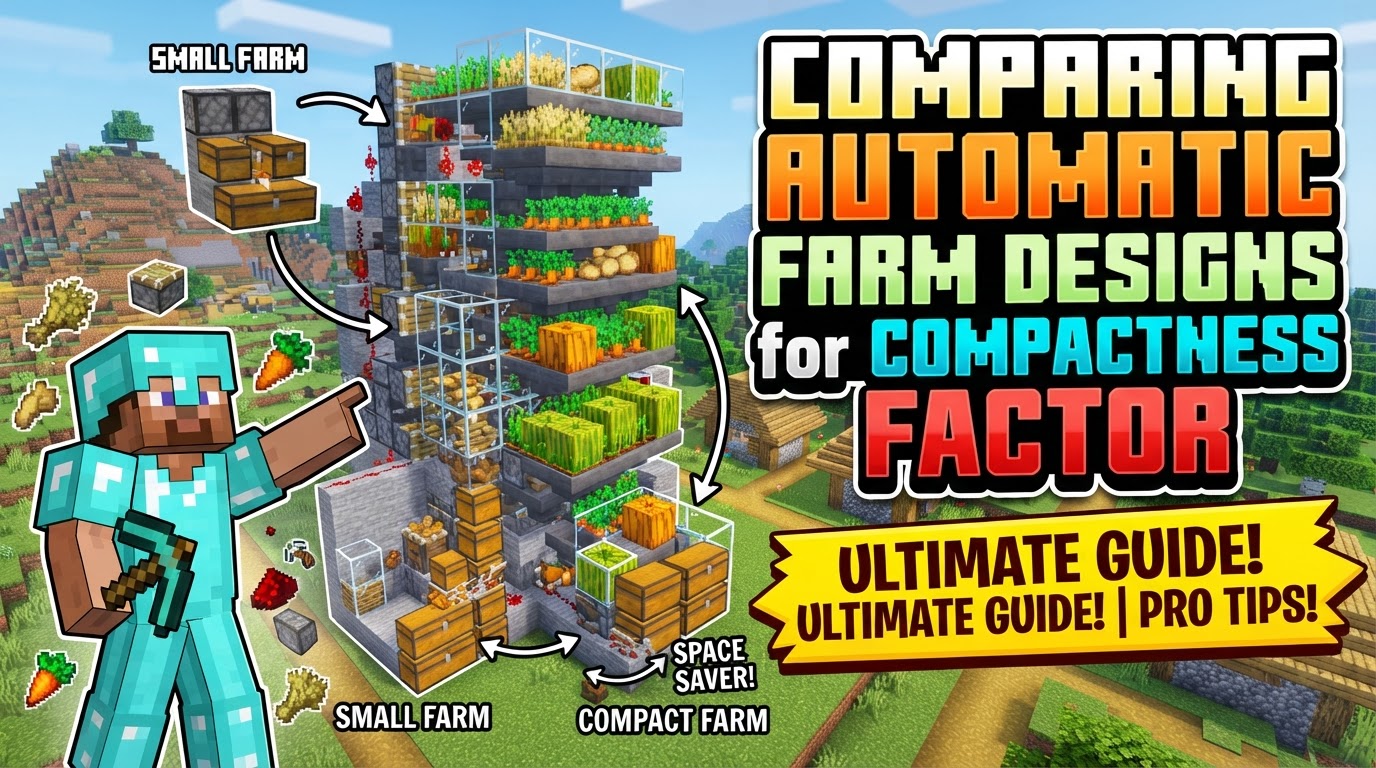
The pursuit of compactness in Minecraft farm design is a constant challenge, pushing players to innovate and deeply understand the game’s underlying mechanics. This guide delves into the core principles, essential techniques, and common pitfalls associated with building automatic farms that are as space-efficient as they are productive.
The Pillars of Compact Farm Design
At the heart of every truly compact and efficient automatic farm lies a deep understanding of specific Minecraft mechanics. Leveraging these game features allows players to automate processes that would otherwise require constant manual intervention, all while minimizing the farm’s physical presence.
- Redstone Automation: The lifeblood of automation, Redstone components like observers, pistons, and dispensers are crucial for compact designs. Observers, in particular, are invaluable for detecting block updates or plant growth directly, triggering harvesting mechanisms with precision and minimal Redstone wiring. Pistons can push or break blocks, while dispensers can place or use items, all within tight spaces.
- Hoppers and Water Streams: Efficient item collection and transport are non-negotiable for compact farms. Hoppers automatically pick up items from above and move them into connected inventories, forming the backbone of any collection system. Water streams, on the other hand, can carry items across longer distances or into a central collection point, often serving a dual purpose, such as hydrating crops.
- Entity Cramming: As mentioned, this mechanic is pivotal for compact animal farms. By confining more than 24 entities (like chickens or cows) to a single block, the game automatically culls the excess, leaving behind drops that can be collected via hoppers. This allows for incredibly dense and productive mob farms.
- Villagers: For certain agricultural farms, villagers are surprisingly effective. They can be employed to plant, harvest, and collect various crops, often requiring minimal player interaction once set up correctly. Their AI pathfinding and interaction with specific blocks make them valuable allies in compact crop production.
- Tick-Based Growth/Updates: Many automatic farms exploit the game’s internal tick system. Plants like sugar cane, bamboo, and kelp grow based on game ticks, and observers can detect these growth events (block updates) to trigger pistons for automatic harvesting. This allows for continuous production without player presence.
A Blueprint for Space-Efficient Automation
Building a compact automatic farm isn’t just about throwing Redstone and blocks together; it requires a systematic approach. Following these general principles will guide you toward optimized designs.
- Clarify Your Objective: Before placing a single block, determine the specific resource you need. Is it food, building materials, XP, or something else? The resource dictates the farm type, which in turn influences the most effective compact design.
- Grasp the Core Game Mechanic: Understand the primary mechanism driving your chosen farm. For example, a sugar cane farm relies on piston harvesting triggered by observers, while an animal farm leverages entity cramming. A clear understanding prevents over-engineering and allows for minimalist designs.
- Prioritize a Minimal Footprint: This is the essence of compactness. Always strive to use the smallest possible ground area. This often means building upwards, stacking layers, or integrating components vertically rather than horizontally.
- Automate Resource Collection: A truly automatic farm is useless if its output isn’t collected. Implement hoppers directly under collection points, leading to chests or a more elaborate storage system. This prevents items from despawning or accumulating in inaccessible areas.
- Integrate Redstone Logic: Design Redstone circuits that are as simple and efficient as possible. Use observers to detect changes directly, and employ pistons and repeaters (only if necessary) to trigger actions. Avoid overly complex Redstone that takes up unnecessary space.
- Iterate and Refine: Don’t expect perfection on the first try. Build a small prototype of your design to test its functionality and efficiency. This process often reveals opportunities for further space optimization or improvements in output.
Advanced Techniques for Minimizing Farm Dimensions
Once the foundational principles are understood, specific techniques can be applied to push the boundaries of compactness even further.
- Embrace Verticality: The most straightforward way to save horizontal space is to build up. Stack multiple farm layers on top of each other, sharing a central collection system or Redstone clock. Redstone components can often be placed above, below, or even within the farming area itself, rather than sprawling horizontally.
- Leverage Multi-functional Blocks: Look for blocks that serve more than one purpose. For instance, a single block of water can hydrate multiple crop plots while simultaneously acting as an item transport system, flowing harvested items towards a hopper.
- Strategic Observer Placement: Observers are your best friends for compactness. Place them directly adjacent to growing plants (like sugar cane, bamboo, kelp) or blocks that will be updated (e.g., when a pumpkin or melon grows) to detect changes instantly and trigger a piston. This eliminates the need for bulky Redstone lines.
- Share Common Components: Design farms where a single Redstone clock, power source, or collection system can efficiently serve multiple farming units or layers. A single Redstone pulse from a clock can activate pistons on several levels simultaneously, drastically reducing the Redstone footprint.
- Explore Micro Farm Concepts: Research and experiment with “micro farm” designs. These are highly optimized farms specifically engineered to be as small as possible while maintaining full functionality, often requiring precise placement of every single block and Redstone component.
Common Obstacles to Compactness and Functionality
Even the most experienced builders can fall prey to common mistakes that undermine a farm’s compactness or overall effectiveness.
- Version Incompatibility: Minecraft has significant differences between its Java and Bedrock Editions. A farm design optimized for one version may not work at all in the other due to varying Redstone mechanics, mob behaviors, or block interactions. Always verify the intended game version of any tutorial or design you follow.
- Inadequate Storage Solutions: A common oversight is failing to implement sufficient storage. If chests aren’t connected to hoppers or if they fill up too quickly, harvested items will either despawn or clog the hopper system, halting production. Plan for storage capacity that matches or exceeds your farm’s output rate.
- Incorrect Mob Spawning Conditions: For mob-based farms (like iron golem farms or general mob grinders), precise conditions are critical. Issues can arise from incorrect villager linking, insufficient light levels (for hostile mobs), or exceeding the global mob cap in nearby areas, which prevents new mobs from spawning.
- Biome-Specific Limitations: Certain farms, particularly those relying on specific mob spawns (e.g., slimes in a slime chunk) or environmental conditions, may not function correctly if built in the wrong biome. Always consider the environmental requirements of your chosen farm type.
- Misplaced Composters: In villager-based crop farms, the composter acts as the villager’s job block. If it’s placed incorrectly or if the villager has access to too many composters, they might prioritize composting seeds rather than harvesting and replanting desired crops, significantly reducing the farm’s output.
Ultimately, designing compact automatic farms in Minecraft is a rewarding challenge that combines creativity with a deep understanding of game mechanics. By focusing on verticality, efficient Redstone, smart item collection, and avoiding common pitfalls, players can create highly productive farms that fit into the smallest possible spaces, enhancing their survival experience and proving their mastery of the blocky world.
Tags:
YOU MAY ALSO LIKE...