Create Mod Ultimate Factory
A single, well-designed Create mod factory can process thousands of items per minute, transforming raw materials into complex components with breathtaking efficiency. Building an “Ultimate Factory” in Create isn’t just about making things work; it’s about optimizing every gear, belt, and pipe for maximum throughput, minimal waste, and seamless scalability. It’s a grand engineering challenge that culminates in a sprawling, automated marvel.
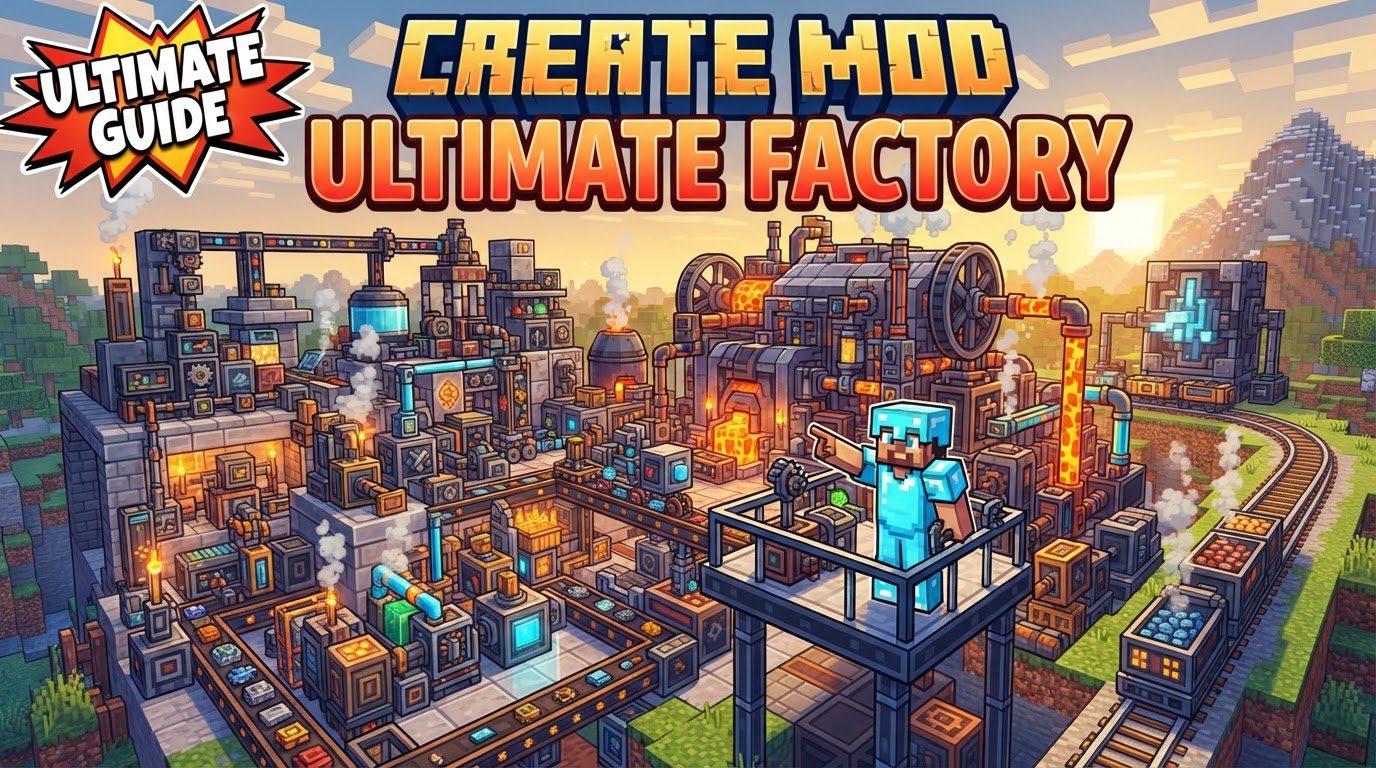
The journey to an Ultimate Factory involves mastering several core aspects of the Create mod, integrating them into a cohesive, highly functional system. This guide breaks down the essential components and design philosophies that define a truly ultimate automated production line.
Automated Resource Acquisition: The Unending Flow
- Description: The foundation of any ultimate factory is a constant, reliable supply of raw materials. This goes beyond simple manual mining. An ultimate factory employs sophisticated, automated systems to extract resources without player intervention. This often starts with large-scale quarrying using Mechanical Drills mounted on Gantry Carriages or intricate networks of Mechanical Miners. These systems are designed to clear vast areas or dig deep shafts, funneling all excavated blocks into your processing lines.
Advanced setups might involve automated tree farms using Deployers and Mechanical Saws, or even complex contraptions for farming specific crops or mob drops. The key is not just automation, but also sustainability; ensuring that your resource generation can keep pace with your consumption, or even exceed it, creating a buffer for future expansion. Filters and smart chutes are crucial here to separate valuable ores from cobblestone and dirt, routing only necessary items into the main system.
Intelligent Transport Networks: The Veins of Industry
- Description: Raw materials and finished products need to move efficiently across your factory. An ultimate factory’s transport system is a complex web of interconnected components, each chosen for its specific role. Conveyor Belts are the workhorses, moving items horizontally with adjustable speeds. They are often paired with Smart Chutes and Item Vaults for precise routing and bulk storage at various stages of production.
For long-distance or high-volume transport, Minecarts and Contraptions-based Trains become indispensable. Gantry systems can create vertical elevators or complex multi-directional sorting hubs. Fluid Pipes and Mechanical Pumps handle liquids like lava, water, and various Create-specific fluids (e.g., molten iron, ethanol), ensuring they reach their designated processors. The “intelligence” comes from using Item Filters, Smart Funnels, and Redstone Links to ensure items go exactly where they’re needed, preventing bottlenecks and ensuring maximum throughput.
Modular Processing Lines: Crafting at Scale
- Description: The heart of an ultimate factory lies in its processing capabilities. Raw materials are transformed through a series of automated steps, each performed by specialized Create blocks. Ore doubling is often achieved with Crushing Wheels, while impurities are removed using Washing Fans. Mechanical Mixers combined with Basins are used for crafting alloys, mixing dyes, or creating new compounds.
Mechanical Presses flatten ingots into sheets, and Deployers, often mounted on contraptions, automate complex interactions like placing blocks, right-clicking, or even feeding animals. For multi-step crafting recipes, Mechanical Crafters are arranged in intricate grids, synchronizing their operations to produce advanced components like circuits or complex machinery. Each processing line is designed to be modular, allowing for easy replication and expansion without redesigning the entire factory. Parallel processing – running multiple identical lines simultaneously – is key to achieving high production rates.
Robust Power Generation: The Heartbeat of Production
- Description: Every moving part in a Create factory demands kinetic energy. An ultimate factory doesn’t just generate power; it generates a surplus, efficiently and reliably. Early-game factories might rely on simple Water Wheels or Windmills, but an ultimate setup inevitably transitions to powerful Steam Engines. These require a consistent supply of fuel (wood, coal, blaze cakes) for Blaze Burners to heat water, turning it into steam that drives large rotational mechanisms.
Designing a robust power system involves careful calculation of Stress Units (SU) and Rotational Speed (RPM). Gearboxes, large and small cogs, and adjustable gearshift are used to distribute power effectively, converting high torque/low speed into low torque/high speed where needed. Redundancy in power generation, perhaps with multiple steam engines or a mix of power sources, ensures that a momentary hiccup in fuel supply or water flow doesn’t bring the entire factory to a halt.
Advanced Item Management & Logistics: The Brains of the Operation
- Description: Beyond simple transport, an ultimate factory requires sophisticated item management to prevent overflow, manage stock levels, and dynamically route items. This is where Smart Chests, Smart Funnels, and Stockpile Switches truly shine. Items can be filtered based on type, NBT data, or even quantity, allowing for precise control over inventory.
Redstone Links provide wireless control, enabling complex timing mechanisms, remote activation of machinery, or emergency shutdowns. Automated sorting systems, often employing arrays of chutes and filters, can categorize hundreds of different items into dedicated storage. Depots, Bellows, and Weighted Ejectors add further layers of control, allowing for precise item placement and dynamic distribution. The goal is a factory that not only produces but also intelligently manages its output and raw material consumption, adapting to changing production demands without manual intervention.
Scalability and Aesthetics: The Form and Function
- Description: An ultimate factory isn’t just functional; it’s a masterpiece of engineering and design. Scalability is built-in from the ground up, meaning individual processing modules can be easily duplicated and integrated to increase production capacity without tearing down existing infrastructure. This often involves designing compact, repeatable units that can be stacked or placed side-by-side.
Beyond pure function, Aesthetics play a crucial role. A truly ultimate factory is visually impressive, integrating seamlessly into its environment or standing as a grand industrial monument. This involves careful consideration of block palettes, lighting, and the overall layout. Visualizing the flow of items and power through transparent blocks or open designs can enhance both understanding and appeal. Furthermore, an ultimate factory is optimized for performance, minimizing lag by carefully managing contraption complexity and block updates, ensuring the magnificent creation runs as smoothly as it looks.
Getting Started with Create: Installation Brief
To embark on your journey to building an ultimate Create factory, you first need to install the mod. The Create mod is available for both Minecraft Forge and Fabric mod loaders. Simply download the correct version from a reputable source like CurseForge, ensuring it matches your Minecraft version. Place the downloaded .jar file into your Minecraft ‘mods’ folder (located in your .minecraft directory). Launching Minecraft with Forge or Fabric will then load the Create mod, allowing you to begin experimenting with its kinetic-energy-based automation and intricate machinery.
Tags:
YOU MAY ALSO LIKE...