How Armor Durability Loss Accumulates Over Time
For every four hearts of damage (eight health points) a player sustains, their worn armor collectively loses one durability point. This seemingly simple rule underpins one of Minecraft’s most critical mechanics: the gradual degradation of your protective gear. Understanding how armor durability loss accumulates over time is not just about keeping your diamond chestplate intact; it’s about strategic resource management, efficient enchanting, and ultimately, survival in a world teeming with dangers.
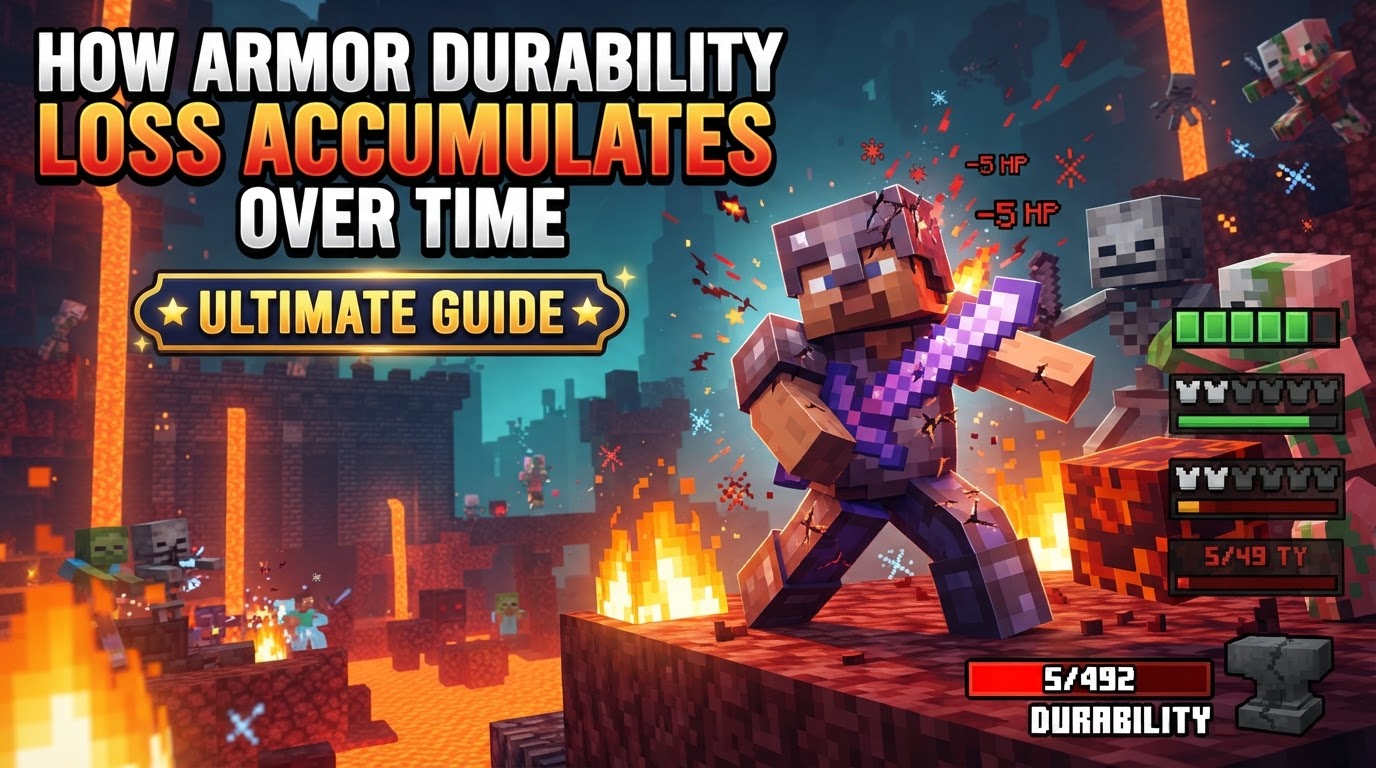
Armor durability is the lifeline of your protective equipment, a hidden counter that ticks down with every blow, explosion, and environmental hazard. While the visual bar beneath your item icon in the inventory offers a clear indication of its current state-green when full, gradually turning red as it depletes-the underlying process is a nuanced interplay of damage types, calculations, and enchantments that dictate how quickly your gear crumbles to dust.
The Mechanics of Wear and Tear
The primary driver of armor degradation is straightforward: taking damage. However, not all damage is created equal in the eyes of your armor. Durability loss is specifically tied to damage sources that directly impact the armor’s protective function. This includes:
- Mob Attacks: Hits from zombies, skeletons, spiders, and other hostile creatures.
- Projectiles: Arrows, ghast fireballs, blaze fireballs, and other ranged attacks.
- Explosions: Damage from creepers, TNT, or ghast fireballs detonating nearby.
- Environmental Hazards: Direct contact with damaging blocks like Cactus or immersion in Lava.
Crucially, the game calculates durability loss based on the total “damage” absorbed by the armor. For every four hearts (equivalent to eight health points) of incoming damage that the player takes, one point of durability is collectively removed from the armor pieces currently mitigating that damage. This means that a single powerful blow or sustained attacks will contribute to a more rapid accumulation of durability loss.
Conversely, certain types of damage do not affect armor durability. These include:
- Fall Damage: Unless boots possess specific enchantments like Feather Falling, which can sometimes indirectly interact with durability in complex scenarios, standard fall damage bypasses armor.
- Drowning Damage: Suffocation underwater does not wear down your gear.
- Burning Damage: Damage from being on fire, without direct contact with a damaging block like lava, does not reduce armor durability.
Higher-tier armor, such as diamond and netherite, introduces a stat called Armor Toughness. While not directly related to durability loss per hit, Armor Toughness helps reduce the effectiveness penalty of armor against high incoming damage. By mitigating more damage, it indirectly reduces the overall “damage absorbed” by the player, thus potentially slowing down the collective durability drain over time, especially in intense combat scenarios.
A Step-by-Step Look at Durability Loss
To fully grasp how durability accumulates, it’s helpful to break down the process the game follows each time your character takes damage:
- Damage Taken: The player receives damage from a source that is designed to affect armor, such as a zombie’s attack or a skeleton’s arrow.
- Durability Calculation: The game determines the total damage absorbed. Based on the 4 hearts (8 health points) to 1 durability point ratio, it calculates how many durability points should be lost from the worn armor pieces that contributed to mitigating this specific damage instance.
- Unbreaking Check (if enchanted): If any of the affected armor pieces have the Unbreaking enchantment, a probabilistic check is performed. The higher the level of Unbreaking (e.g., Unbreaking III), the greater the chance that the durability loss for that particular instance will be completely negated. This is where Unbreaking significantly slows down the accumulation of wear.
- Durability Reduction: If the Unbreaking check fails, or if the armor piece does not possess the enchantment, the calculated durability points are deducted from the respective armor piece.
- Breakage: When an armor piece’s durability reaches zero, it breaks. The item is then removed from the player’s inventory, leaving them vulnerable in that slot.
It’s also important to note that different armor pieces within the same material set can have varying maximum durabilities. For instance, helmets and boots often have lower base durabilities than chestplates and leggings made of the same material. This means that, even with even damage distribution, certain pieces might reach zero durability and break faster than others, requiring more frequent attention.
Mastering Armor Longevity Through Enchantments and Repairs
Given the constant threat of durability loss, effective management is paramount. The Minecraft world offers powerful tools to extend the life of your gear indefinitely, turning a finite resource into a sustainable one.
- Unbreaking Enchantment: This is your first line of defense against rapid durability loss. Unbreaking provides a chance for an item to avoid losing durability when it would normally do so. An Unbreaking III enchantment, for example, makes an item last up to four times longer on average by significantly reducing the frequency of durability deductions. This directly combats the accumulation of wear over time.
- Mending Enchantment: Mending is a game-changer for long-term gear maintenance. When an item enchanted with Mending is held or worn, any experience orbs collected by the player will be used to repair that item. Each experience point collected restores two durability points. This allows for continuous, passive repair, effectively reversing the accumulation of durability loss as you play.
- Combine Mending and Unbreaking: The synergy between these two enchantments is the cornerstone of optimal armor management. Unbreaking III drastically slows down how quickly your armor loses durability, meaning that each experience orb collected to mend the item becomes significantly more efficient. Less durability is lost, so less XP is needed to restore it, creating a highly sustainable system.
- Repair Mechanics: When enchantments aren’t an option, or for quick fixes, players can use repair stations. A Grindstone can combine two damaged items of the same type, averaging their durability and removing all enchantments. An Anvil can also combine two items or repair an item with raw materials, importantly retaining enchantments, though at an increasing experience cost and potential “too expensive” limit.
- XP Farms: To fully leverage Mending, especially for multiple enchanted items, establishing an experience farm is highly recommended. These automated or semi-automated setups allow players to quickly gather large amounts of experience orbs, ensuring their Mending-enchanted gear remains at full durability.
Common Misconceptions and Strategic Advice
Even seasoned players can fall prey to common mistakes regarding armor durability:
- Ignoring Enchantments: One of the most frequent oversights is neglecting to apply Unbreaking and Mending to valuable gear. This leads to a constant cycle of crafting new armor, which is resource-intensive and inefficient.
- Believing Unbreaking Grants Invincibility: Unbreaking does not make an item truly unbreakable. It merely introduces a chance to skip durability loss on a given instance. Over many instances of damage, durability will still eventually deplete, albeit at a much slower rate.
- Not Repairing Proactively: Waiting until armor is on the verge of breaking before seeking repairs can lead to disastrous consequences. A broken chestplate in the middle of a battle can be the difference between life and death. Regular checks and timely repairs, particularly with Mending, prevent such critical failures.
- Underestimating Environmental Damage: It’s easy to forget that seemingly minor hazards like walking through a cactus field or briefly touching lava can chip away at your armor’s durability. These small, accumulated losses can add up over time, especially if not managed.
Understanding how armor durability loss accumulates over time transforms a simple game mechanic into a strategic element. By leveraging enchantments, understanding repair options, and being mindful of damage sources, players can ensure their protective gear remains a reliable shield against the many perils of Minecraft, allowing for deeper exploration and more ambitious builds without the constant worry of their equipment failing.
Tags:
YOU MAY ALSO LIKE...