How Knockback Resistance Stacking Works in PvP
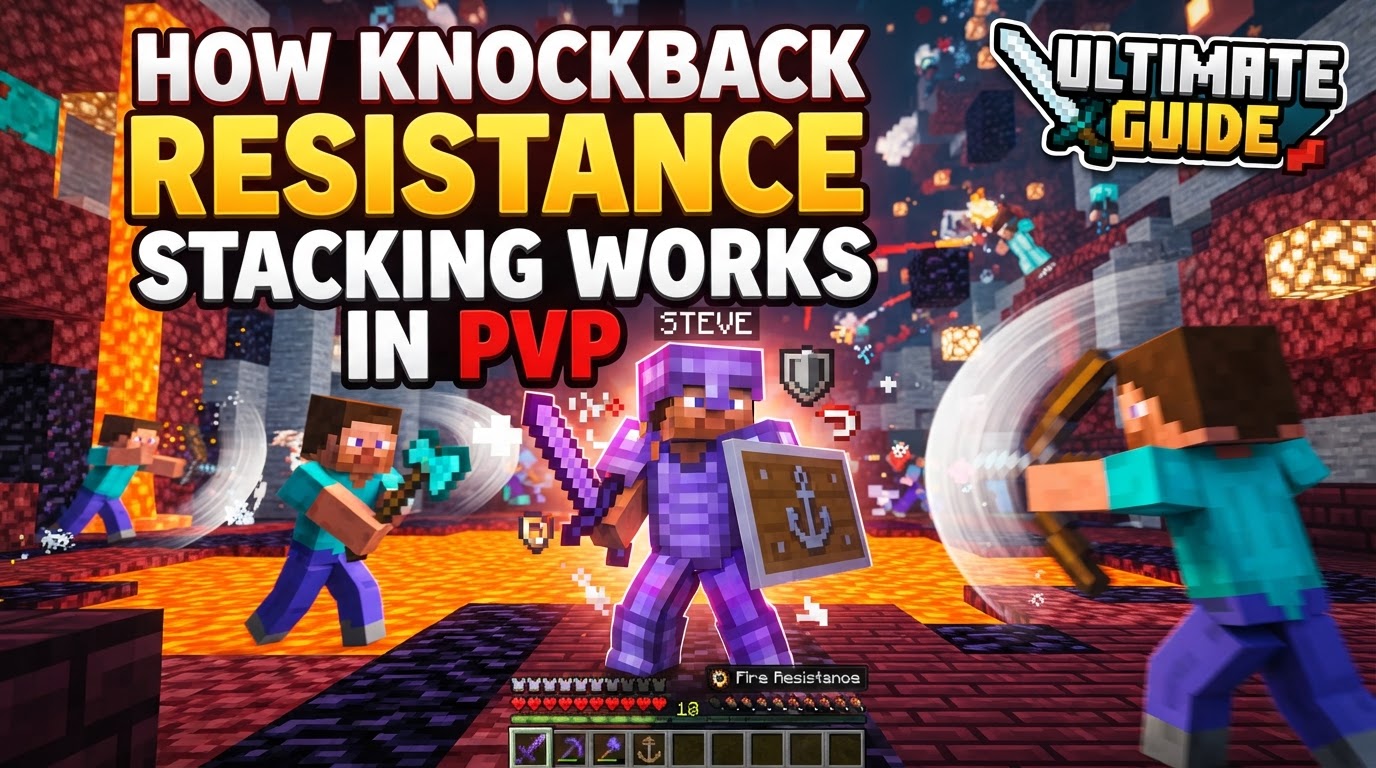
Contrary to a widely held belief among aspiring PvP enthusiasts, landing a critical hit in Minecraft does not inherently increase the knockback you inflict on an opponent. While a satisfying visual cue, the real power behind displacing your foes, and more importantly, resisting displacement yourself, lies in a sophisticated interplay of mechanics and techniques. Mastering these elements of knockback resistance is not just about armor values; it’s about timing, movement, and a deep understanding of the game’s physics. This guide will unravel the intricate world of knockback in Minecraft PvP, detailing how various factors contribute to both receiving and mitigating its effects.
Understanding the Force: Core Knockback Mechanics
Knockback is a fundamental aspect of Minecraft PvP, capable of breaking combos, creating distance, or even sending players plummeting to their demise. While it might seem straightforward, several key mechanics influence how much knockback is dealt and received.
- Netherite Armor: Your Foundational Defense: Wearing a full set of Netherite armor provides an inherent level of knockback resistance. This means that even without any special techniques, players in Netherite will experience less displacement from incoming attacks compared to those in other armor types. It’s your baseline for survival in a knockback-heavy environment.
- The Potency of Sprint Hits: One of the most significant sources of increased knockback in PvP comes from sprint hits. When a player attacks while sprinting, the resulting hit deals substantially more knockback than a static or walking attack. This mechanic is crucial for aggressors looking to control their opponent’s positioning.
- Knockback Enchantment: Weaponizing Displacement: A weapon enchanted with ‘Knockback’ is designed specifically to maximize the displacement of enemies. Each level of the enchantment significantly increases the distance an opponent is pushed back, making it a powerful tool for zoning, crowd control, or environmental kills.
- Momentum’s Influence on Knockback: The game engine registers your current momentum, and this can be manipulated to your advantage. Techniques that add velocity to your movement, such as jump resetting, can effectively “soften” incoming knockback by overriding or reducing the impact of the opponent’s force.
- Directing the Force: Attacker’s Look Direction: For sprint hits and attacks from weapons with the Knockback enchantment, the direction in which the opponent is launched isn’t solely determined by the point of impact. Instead, it’s heavily influenced by the attacker’s look direction at the moment of the hit. Savvy players can quickly adjust their camera before striking to alter the trajectory of their opponent’s knockback, often pushing them into unfavorable positions or off ledges.
- Critical Hits: A Damage, Not Knockback, Modifier: It’s a widespread misconception that critical hits deal more knockback. In reality, critical hits only increase damage output. The increased knockback often associated with them is typically a result of the player simultaneously performing a sprint hit, which is the true source of the added displacement.
The Unexpected Power of Blast Protection Stacking
While most knockback resistance comes from armor and player techniques, there’s a unique and often contentious form of knockback resistance that specifically applies to explosions: Blast Protection. Recently, it has been observed that Blast Protection enchantments, when stacked across multiple armor pieces, provide a cumulative reduction in knockback from explosive sources such as TNT, End Crystals, or Ghast fireballs. This stacking can become so potent that players can effectively negate all knockback from explosions, standing firm even amidst powerful blasts. This particular mechanic has been flagged by many in the PvP community as creating gameplay imbalances, particularly in specialized game modes where explosive damage is prevalent.
Advanced Techniques for Mitigating Knockback
Beyond passive armor benefits, skilled players actively employ dynamic techniques to reduce the impact of incoming knockback, maintaining control and continuing their offensive.
- The Precision of Jump Resetting: This is a cornerstone technique for reducing knockback. The core idea is to time a jump precisely as you are about to be hit again, or just as your feet are about to touch the ground after a previous jump. By pressing the jump key at this critical moment, you register new momentum, adding upward velocity that counteracts the horizontal force of the knockback. It’s vital to be holding ‘W’ (sprinting forward) during this process to ensure you gain forward momentum. This technique effectively “softens” the knockback, allowing you to recover faster and maintain your offensive. A common mistake is to simply hold the spacebar; instead, precise, timed presses are key.
- Strategic Hit Selecting: When you anticipate being hit or are about to enter an opponent’s reach, timing your own attack to land immediately after you receive damage can be incredibly effective. This technique, known as hit selecting, allows you to “trade” hits and potentially maintain your combo or prevent the opponent from establishing their own, despite being briefly knocked back.
- Counter-Strafing and A&D Tapping: These techniques involve rapidly changing your strafe direction (e.g., spamming ‘A’ and ‘D’ keys) right as you are struck. This creates a directional conflict for the game’s knockback calculation, effectively reducing the opponent’s ability to efficiently displace you. By breaking the clean trajectory of their knockback, you can land faster, reset your position sooner, and set yourself up for subsequent attacks or evasive maneuvers.
- W-Tapping for Consistent Control: W-tapping involves momentarily releasing and then re-pressing the ‘W’ key while attacking. This action resets your sprint status, allowing you to consistently land sprint hits – which are crucial for dealing maximum knockback – while also giving you a brief moment to adjust your movement and slightly mitigate incoming knockback by resetting your momentum. It’s a delicate balance of offense and defense.
Strategic Tips for Dominating Knockback in PvP
Beyond understanding the mechanics and executing techniques, several strategic considerations can give you an edge.
- Timing is the Ultimate Skill: The effectiveness of jump resets, hit selections, and W-taps hinges entirely on precise timing. Consistent practice is the only way to internalize these timings and execute them flawlessly under pressure.
- Optimizing Your Aim for Different Scenarios: For your initial attack, aiming at the opponent’s neck or upper chest can improve hit registration and ensure your knockback connects cleanly. However, when performing jump resets or maintaining a combo, especially if the enemy is airborne, aiming lower – around the legs or feet – can significantly improve reach consistency and hit registration, allowing you to keep them in your combo.
- Leveraging Environmental Factors: The environment can be your best friend or worst enemy. Utilizing elements like water (which significantly slows movement and reduces knockback) or cobwebs (which trap opponents and can be used to recover from knockback) can provide crucial advantages.
- The Advantage of Low Latency: A stable and low ping (network latency) is always an advantage in PvP, and knockback is no exception. Better ping ensures more accurate hit registration, more consistent knockback application, and more reliable execution of your own knockback reduction techniques.
Common Misconceptions and Emerging Imbalances
As discussed earlier, the belief that critical hits inherently increase knockback is a persistent myth; sprint hits are the true source. Another common error is holding the spacebar during jump resets, which is less effective than precise, timed jumps.
The most significant emerging imbalance concerns Blast Protection. While designed to mitigate explosion damage, its ability to completely nullify explosion knockback when stacked has led to scenarios where players are virtually impervious to environmental displacement from blasts, creating an unfair advantage in certain game modes and altering traditional PvP strategies.
Mastering knockback in Minecraft PvP is a journey that combines equipment knowledge, mechanical skill, and strategic awareness. By understanding the core mechanics, practicing advanced reduction techniques, and adapting to environmental factors, you can significantly improve your resilience and control in any combat scenario.
Tags:
YOU MAY ALSO LIKE...