How to Build Bases That Block Spectator Mode Viewing
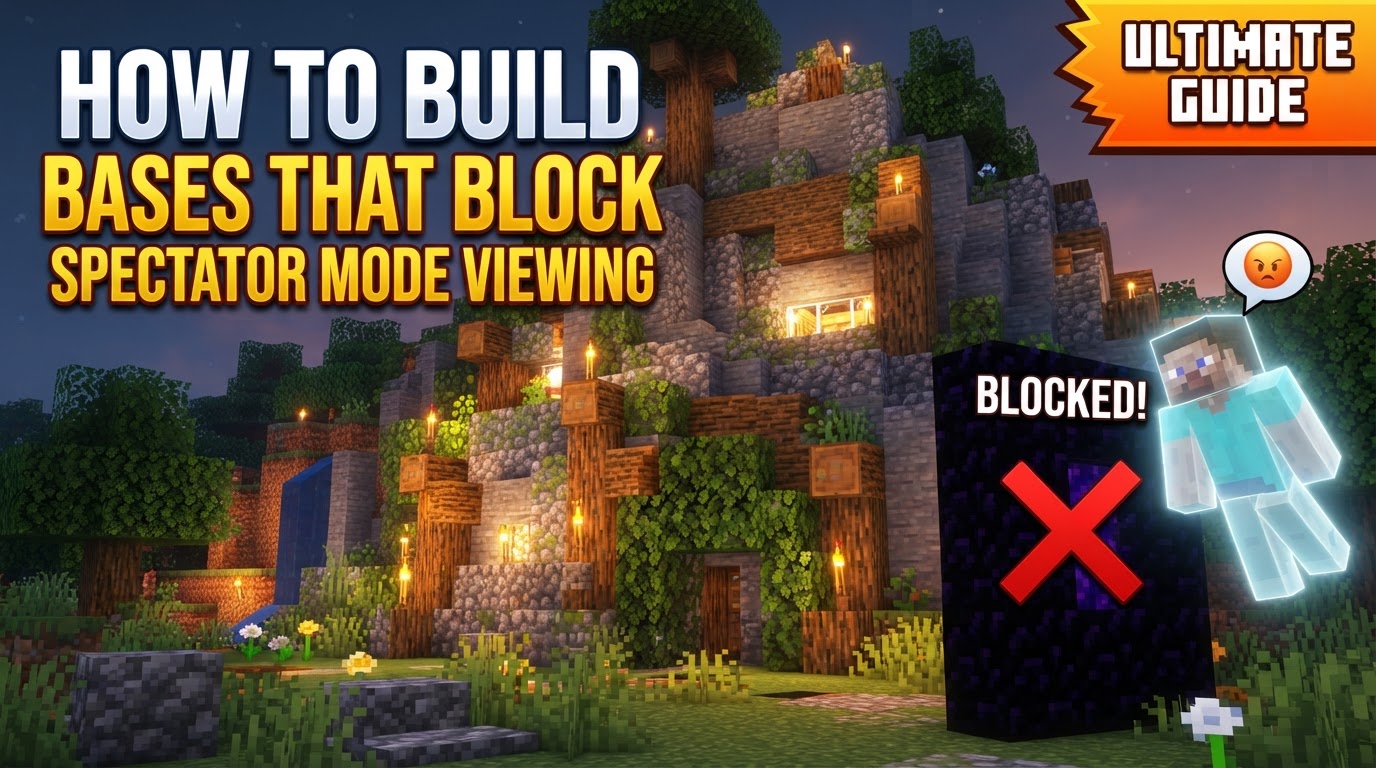
The stark truth about Minecraft’s Spectator Mode is that, in vanilla gameplay, it is fundamentally impossible to completely “block” a player in this mode from viewing your base. Spectator Mode inherently grants players an unparalleled ability to fly through any blocks and entities, effectively providing them with X-ray vision. This core mechanic means that no matter how thick your walls or how deep your bunker, a determined spectator can always phase through and observe your creations. However, this doesn’t mean you’re entirely defenseless. While absolute prevention isn’t an option, you can employ a range of sophisticated techniques and, in some cases, server-side modifications, to significantly hinder, complicate, and even deter a spectator’s ability to effectively spy on your base.
Understanding the Spectator’s Unrestricted Gaze
To effectively counter a threat, one must first understand its capabilities. Spectator Mode, a standard feature in Minecraft Java Edition and also available in Bedrock Edition (though its implementation may vary across versions), bestows several powerful abilities upon the player, making traditional base defenses obsolete:
- No Clip Capability: This is the most critical feature. Players in spectator mode can freely move through any block, entity, or player. When their camera is inside a block, they can see through all other blocks, granting them full X-ray vision. This bypasses all physical barriers, rendering even obsidian walls transparent to their view.
- Invisibility: Spectators are completely invisible to other players (unless those players are also in spectator mode) and all mobs. This allows them to approach, observe, and even linger around a base without any risk of detection or engagement from the base’s occupants or environmental threats.
- Enhanced Mobility: Beyond simply flying, spectators often have increased flight speed and maneuverability, allowing them to traverse vast distances and intricate structures with ease.
Given these capabilities, the goal shifts from outright blocking to sophisticated concealment, misdirection, and obstruction, making the act of spying as arduous and unrewarding as possible.
The Vanilla Strategy: Concealment Through Buffer Zones
Since no vanilla block can truly block a spectator, the most effective vanilla strategy focuses on creating layers of obstruction and complexity. The primary technique involves implementing a “buffer zone” or “air layer” around your base. This method doesn’t prevent a spectator from flying through, but it forces them to make a conscious effort to navigate multiple layers, making a casual fly-by less effective.
Here’s a step-by-step process for implementing this:
- Construct Your Core Base: Begin by building the functional heart of your base. This should be deep underground or in a naturally hidden location from the outset. Focus on the internal layout and functionality without immediate concern for external defenses.
- Erect an Inner Wall: Once your core base is laid out, construct the true, functional walls of your base. These are the walls that define your living spaces, storage areas, and vital mechanisms. This inner wall should be robust, but its material choice is less critical for spectator deterrence than its position.
- Integrate the Air Layer: This is the crucial step. Around the entirety of your inner wall, create a hollow space – an “air layer” or empty buffer zone. This gap should be at least one block thick, but ideally two or more blocks for better obfuscation. This empty space exists between your base’s true walls and the eventual outer shell. When a spectator phases through the outer shell, they will first enter this empty void, rather than immediately seeing your base’s interior. This forces them to actively continue flying through another layer to gain true visibility.
- Build a Deceptive Outer Shell: Construct a thick, solid outer shell around the entire air layer. This shell is the first line of visual defense. Its primary purpose is to blend seamlessly with the surrounding natural terrain. Use blocks that match the environment – stone deep underground, dirt and grass near the surface, or specific netherrack/end stone if building in those dimensions. The thicker and more natural this shell appears, the less likely a spectator will suspect a base lies within.
The effectiveness of this method lies in creating a multi-layered barrier that requires deliberate navigation. A spectator flying through will first encounter the natural-looking outer shell, then an empty void, and only then the inner workings of your base. This adds precious seconds and requires a more focused effort to observe, potentially deterring casual snooping.
Advanced Techniques for Enhanced Deterrence
Beyond the air layer, several other strategies can significantly amplify your base’s stealth and make life harder for a spectator:
- Deep Underground Placement: This is perhaps the most fundamental tip. Building your base significantly deep underground, ideally below Y-level 30 or even closer to bedrock, makes it exponentially less likely for spectators to randomly stumble upon it. The sheer volume of blocks to fly through makes surface-level scanning impractical.
- Remote and Obscure Locations: Choose areas that are far from common travel paths, spawn points, or prominent landmarks. Desolate oceans, deep caves, remote mountain ranges, or even the void are excellent candidates. The further you are from “civilization,” the less likely you are to be a target of a targeted search.
- Natural Camouflage: Any visible parts of your base’s outer shell, or any potential entrance points, must blend perfectly with the natural environment. Avoid straight lines, unnatural block patterns, or obvious signs of human construction. Utilize natural cave formations, integrate into existing mountainsides, or hide underwater. The goal is to make your base indistinguishable from the natural world.
- Complex Terrain Integration: Utilize naturally complex terrain to your advantage. Building within winding cave systems, dense forests, or intricate ravines makes navigation and observation difficult for spectators. Even with their flight, constantly having to adjust their camera through a maze of natural blocks adds a layer of frustration.
- Server-Side Modifications (Multiplayer Only): On multiplayer servers, the game changes significantly. Dedicated server plugins or mods like “Antispec” exist specifically to address the spectator mode vulnerability. These can be configured to actively prevent spectators from passing through blocks to spy on bases. For instance, they might limit spectator movement to only close to the ground, or require specific permissions (like operator status) to use full no-clip. If you’re on a server, inquire about such plugins, as they offer the only true “blocking” capability.
Common Pitfalls to Avoid
Many players, unaware of Spectator Mode’s true power, make critical errors that render their bases easily discoverable. Avoiding these mistakes is as important as implementing good defenses:
- Believing in “Spectator Proof” Blocks: This is a pervasive misconception. There are no vanilla blocks – not bedrock, not obsidian, not reinforced deepslate – that inherently prevent a spectator from flying through them. Spectator mode bypasses all solid block properties.
- Single-Layer Walls: Relying on thin, single-layer walls for your base is a critical error. Spectators will easily pass through them and immediately see the interior. The air layer strategy directly addresses this by creating a buffer.
- Building Near the Surface: Bases built close to the surface are exponentially more easily discovered. A spectator merely needs to fly overhead and dip down slightly to scan for anomalies. The deeper you go, the more effort is required to find you.
- Ignoring Entrances: Even with a perfectly concealed air-layer base, an obvious or poorly disguised entrance will quickly give away your base’s location to an observant spectator. Entrances need to be as meticulously hidden as the base itself, often using redstone trickery or blending seamlessly into natural features.
- Not Considering Server Modifications: On multiplayer servers, assuming vanilla rules apply can be a grave mistake. Always investigate whether the server has plugins or mods that alter Spectator Mode’s behavior. What might be an effective vanilla strategy could be completely overridden or rendered unnecessary by server-side protections.
In conclusion, while you cannot truly “block” Spectator Mode viewing in vanilla Minecraft, you can become a master of obfuscation and deterrence. By combining deep, remote placement with multi-layered air gaps, natural camouflage, and intelligent use of terrain, you can create a base that is incredibly difficult to find and effectively spy upon. Remember, the goal is not absolute prevention, but to make the effort required to find and observe your base so high that most spectators will simply give up.
Tags:
YOU MAY ALSO LIKE...