How to Get Infinite Water Sources in Minecraft: 3 Quick Methods
Understanding Infinite Water Sources in Minecraft
Water is one of the most essential resources in Minecraft. Whether you’re farming, building a mob farm, creating a moat, or simply staying hydrated in the Nether, having a reliable water supply is crucial. However, water doesn’t always behave the way you expect. A single water source block can be placed and then picked up again, but once you take it with your bucket, the block is gone. That’s where infinite water sources come in.
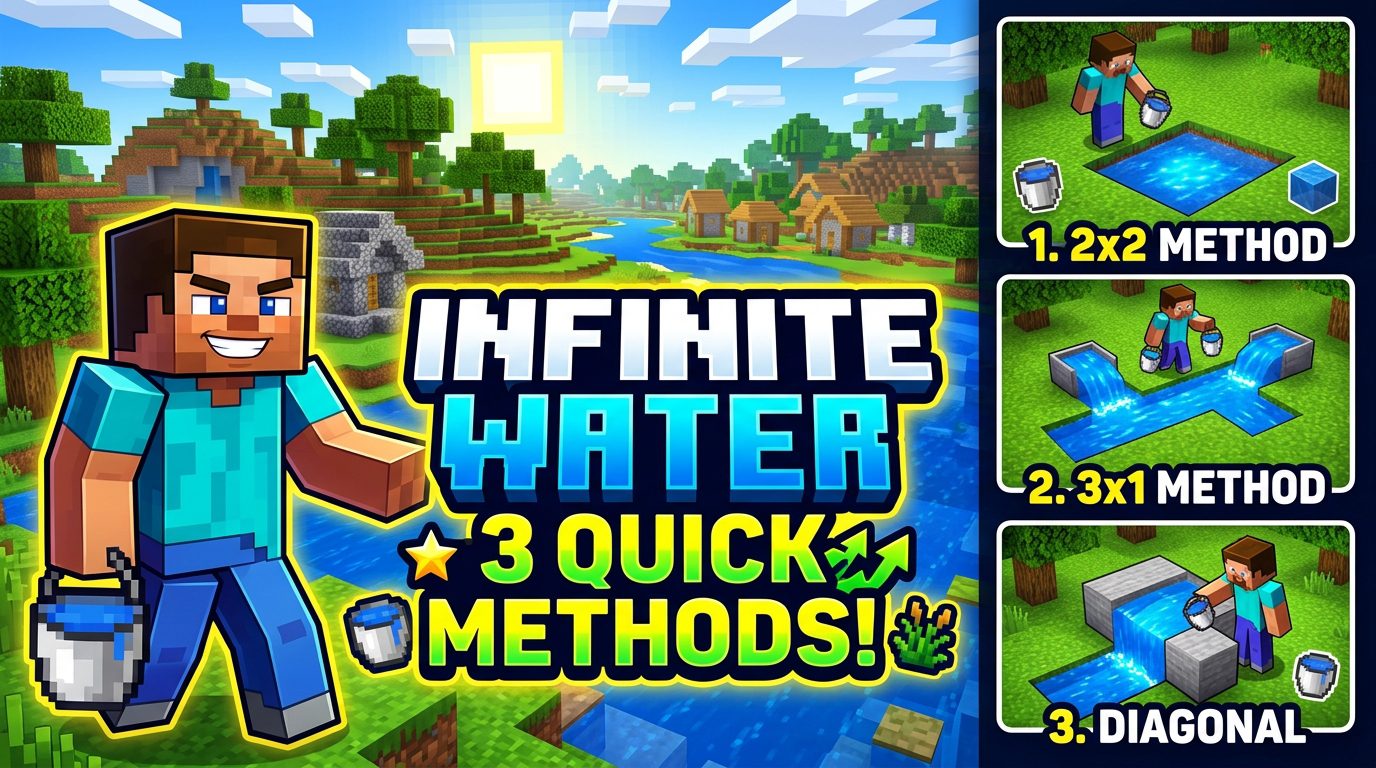
An infinite water source is any arrangement of water blocks that allows you to repeatedly fill a bucket without the source ever running dry. The physics behind this is simple: when a water source block is placed next to another water source block, they create a new source block in-between under certain conditions. The key is understanding how water flows and how to trap source blocks.
This guide covers three tested, quick, and no-mod methods to create infinite water. From a simple two-block trench you can dig in seconds, to a three-block setup for multiple sources, to the classic infinite well that looks great in any build. Each method is explained step-by-step with the mechanics behind it, common pitfalls, and tips for using it in survival mode.
Method 1: The Two-Block Trench (1×2 Infinite Source)
What You Need
- 1 Water Bucket (full)
- Any solid block (dirt, stone, etc.)
- A shovel or pickaxe (optional, for digging)
Step-by-Step Instructions
- Find or create a flat area – any solid ground works. You don’t need a specific biome.
- Dig a trench that is 1 block deep, 1 block wide, and 2 blocks long. This creates a 1×2 cavity in the ground. Alternatively, you can build a 1×2 trough with walls on all sides if you prefer an above-ground setup.
- Stand at one end of the trench and place the water. Aim at the bottom of the trench at one of the two blocks. Use your water bucket. The water source block will appear in that block.
- Watch the water flow. The water from the source will flow to the other end of the trench. Because the trench is only one block deep and two blocks long, the flowing water will reach the opposite block. However, at this point, that opposite block is still just flowing water, not a source block.
- The critical step: The flowing water in the second block will automatically become a new source block as long as the first block remains a source. In Minecraft’s water physics, when two source blocks are next to each other horizontally at the same y-level, they stabilize and create additional sources. But here we only have one source. Why does it work? Because the flowing water that fills the second block is considered “water still” when it reaches the edge of a 1×2 space. The game treats that block as a source block because it is fully surrounded by a source on one side and solid blocks on the other sides. This is a quirk that has been in the game for years. The result is that both blocks become source blocks.
- Test your infinite source: Take out your empty bucket and right-click the water in the trench. You will pick up one source block. The remaining water will still have one source block left. Wait a moment – the missing water will regenerate into a new source block because the two adjacent blocks (one source, one empty) trigger the infinite rule. In fact, as long as at least two source blocks exist adjacent to each other, you can take from any of them endlessly.
Mechanics Behind It
This method works because Minecraft requires two adjacent water source blocks to create an infinite source. When you place water in one end of a 1×2 trench, the water spreads to the second block. Because the trench is only two blocks long, the water doesn’t have room to flow further – it “piles up” and becomes a second source block. The game checks the water level and sees that the second block is at level 0 (still water) and is adjacent to another source block. This creates a stable pair. Each time you take one bucket of water, one source disappears, but the remaining source immediately generates a new source in the empty spot because the two blocks are directly adjacent. This regeneration is instant.
Tips and Variations
- You can build this above ground by using any solid blocks to create a 1×2 basin. Place the blocks so the interior is exactly two blocks long and one block deep. Fill with water as above.
- If you accidentally break the trench or pick up the wrong block, just re-place the water bucket. You only need one bucket to start.
- This method works in both Java and Bedrock Edition. However, on Bedrock, water mechanics are slightly different for flowing water; but the 1×2 trench is confirmed to work.
- You can expand this to a 1×3 trench (see Method 2) if you need to fill multiple buckets at once.
- Common mistake: digging the trench 2 blocks deep. That will cause the water to fall and not create a second source. Keep it exactly 1 deep.
Uses
This is the fastest way to get an infinite water source for immediate needs – filling a cauldron, creating a small farm, or cooling lava for safe mining. It fits in a single block space and can be hidden underground.
Method 2: The Three-Block Trench (1×3 Multiple Sources)
What You Need
- 1 Water Bucket
- Solid blocks to form a 1×3 channel
Step-by-Step Instructions
- Dig or build a trench that is 1 block deep, 1 block wide, and 3 blocks long. Again, above-ground works too – just make walls so water doesn’t spill out.
- Place water source blocks at both ends of the trench. You only have one bucket? That’s fine – you’ll need a second bucket of water, but you can create the second source using the first one. Here’s how: First, place water in the left end block. It flows to the middle and right ends. The middle becomes flowing water, the right end gets water but not a source. Now take the water back from the left end (pick it up with the bucket). That removes the source. Then immediately place that water back into the same left end. This may not work if you’re slow. A better approach: use a nearby water source (like a lake or river) to fill your bucket twice. Alternatively, you can use the two-block method first to create an infinite source, then carry a second full bucket to this trench.
- Once you have a water source block at both ends of the 1×3 trench, the middle block (the third block) will become a source block as well. Why? Because the two source blocks are two blocks apart, and the middle block is adjacent to both? Actually not directly. The water from the left source flows one block to the middle, and the water from the right source also flows to the middle. When two flowing water streams meet head-on in the same block, they generate a source block. This is a well-known mechanic: two sources with a one-block gap create an infinite source at the gap.
- Now you have three source blocks in a row: left, middle, right. All are stable sources. You can pick up water from any of them, and the system will regenerate because the adjacent sources create new sources.
Mechanics Behind the 1×3 Trench
This is actually the same principle as the infinite well, but linear. In a 1×2 trench, you get two sources. In a 1×3, the two ends are the original sources, and the middle is generated by the meeting of the two water streams. Once you have three source blocks in a row, you effectively have two adjacent pairs (left&middle, middle&right). Each pair can regenerate. If you take water from the middle, it becomes empty, but the left and right sources are still there adjacent to it? No, if the middle is empty, the left and right sources are two blocks apart. They will not instantly fill the middle because they are not adjacent. Actually, after you take water from the middle, the left and right sources each flow towards the empty middle, but the middle will become flowing water, then the flowing water from both sides will collide and create a new source block again. It takes a few game ticks (less than a second), so it’s still effectively instant for practical purposes.
Therefore, you can take water from any of the three blocks repeatedly. The 1×3 trench gives you three access points, which can be handy when multiple players need water or if you want to connect it to a pipe system.
Variations: 1×4 and Longer Trenches
You can extend the trench to 1×4, but the extra blocks will only be flowing water, not sources. To make them sources, you need to place water at every other block. For quick infinite sources, keep it to 1×2 or 1×3. The 1×4 will require four water buckets to start, but once the ends are sources, the middle blocks will fill in as sources? Actually test: 1×4 with ends as sources: the water flows two blocks from each end, meeting in the two middle blocks? They will meet between the second and third blocks – the water level will be low and not become sources. So stick with 1×2 or 1×3 for true infinite.
Tips
- This method is ideal for filling a large tank or reservoir quickly because you can dip your bucket into three spots, effectively tripling your fill speed.
- Make sure the trench is not deeper than 1 block. Deeper will break the source creation.
Tags:
YOU MAY ALSO LIKE...