Calculating Safe Fall Distances with Different Boots — A Quick Guide
Minecraft’s vast and often vertical landscapes present constant dangers, and fall damage is one of the most common threats to a player’s survival. Understanding how fall damage is calculated and, more importantly, how to mitigate it, is crucial for navigating treacherous cliffs, deep caves, and even managing advanced movement techniques like Elytra flight. This guide will delve into the precise mechanics of fall damage, focusing specifically on how different boots and enchantments can dramatically alter your survivability from various heights.
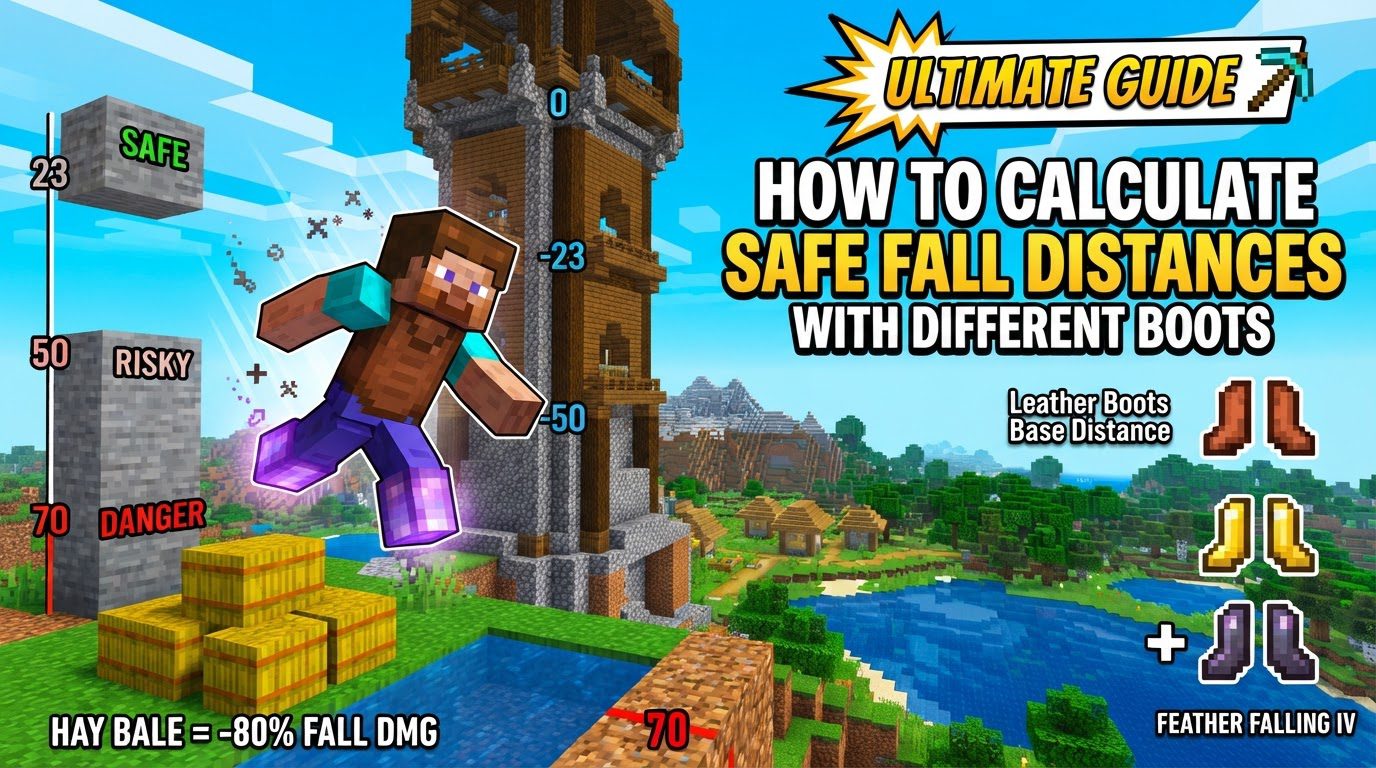
Understanding Fall Damage Mechanics
At its core, fall damage in Minecraft follows a straightforward calculation. Fall damage only begins to apply after a player has fallen more than 3 blocks. This means that a fall of 3 blocks or less will result in no damage whatsoever. However, for every block fallen beyond this initial safe threshold, a player takes a fixed amount of damage. Specifically, for each block fallen past the third, you will incur 0.5 hearts (which translates to 1 damage point) of damage.
The base damage calculation can be expressed as max(0, fall distance - 3) for determining the raw damage points. It’s important to note that standard armor pieces, those without specific enchantments, offer no protection against fall damage. Their defensive properties are primarily for combat-related damage. This makes specialized enchantments vital for increasing your survivability against falls.
The “Feather Falling” enchantment is unique among all enchantments as it is exclusively applied to boots and directly reduces fall damage. This enchantment is your primary defense against falls. While Feather Falling is powerful, another enchantment, “Protection,” can also contribute. The “Protection” enchantment, which can be applied to any armor piece, can stack with Feather Falling to further reduce fall damage. However, there is a hard cap: the total damage reduction from all sources, including Feather Falling and Protection, cannot exceed 80%.
Beyond enchantments, certain landing surfaces offer significant protection. Landing on specific blocks can drastically reduce or even negate fall damage, regardless of the height fallen or the enchantments on your boots. These include water, hay bales, cobwebs, twisting vines, and powder snow. Powder snow, in particular, offers a unique interaction when paired with leather boots, further enhancing its protective properties.
The Role of Boots and Enchantments in Fall Damage Reduction
Your choice of boots, and more specifically, the enchantments they carry, plays the most significant role in determining your safe fall distance. Without any specialized enchantments, a player’s survivable fall distance is quite limited.
- No Feather Falling: If your boots lack the Feather Falling enchantment, your safe fall distance is a mere 3 blocks. Any fall exceeding this will cause damage. A fall of approximately 23 blocks is typically fatal for a player with a full 20 hearts of health (10 hearts displayed). This highlights the extreme vulnerability without enchantments.
- Feather Falling IV: This is the maximum natural level for the Feather Falling enchantment and provides a substantial reduction in fall damage. Feather Falling IV alone reduces fall damage by a significant 48%. With just this enchantment, a player can survive a fall of approximately 41 blocks. This nearly doubles the survivable height compared to having no Feather Falling, making it an essential enchantment for any adventurer.
- Feather Falling IV with full Protection IV: For the ultimate fall damage mitigation, combining Feather Falling IV on your boots with Protection IV on all other armor pieces (helmet, chestplate, and leggings) is the strategy. This powerful combination can provide up to the maximum 80% total damage reduction. With this setup, a player can survive falls of roughly 103 blocks. This allows for incredibly high falls to be survivable, opening up new strategies for traversal and escaping dangerous situations. It’s crucial to remember the 80% damage reduction cap; no combination of enchantments will allow for complete immunity to fall damage from extreme heights, though it will make you incredibly resilient.
Calculating Potential Fall Damage
To precisely understand how much damage you might take from a fall, you need to apply the damage reduction percentages to the base fall damage. The base fall damage is calculated as (fall distance - 3) * 0.5 hearts. Once you have this base damage, you can apply your enchantment-based reduction.
For example, if you have Feather Falling IV, which reduces damage by 48%, you would calculate the damage as Base Damage * (1 - 0.48). If you have the full Protection IV setup reaching the 80% cap, the damage would be Base Damage * (1 - 0.80). This final damage figure can then be compared to your current health to determine if the fall is survivable.
Leveraging Landing Surfaces for Extreme Falls
While enchantments significantly improve fall survivability, certain blocks can completely negate or drastically reduce fall damage, regardless of the height. These “soft landing” blocks are invaluable for navigating extreme heights or escaping perilous situations.
- Water: Landing in water, even a single block deep, completely negates all fall damage. This is a classic “MLG water bucket” maneuver, where players place a water block just before landing to survive any fall.
- Hay Bales: Landing on a hay bale reduces fall damage by 80%. This is an excellent alternative to water for controlled descents or emergency landings, especially when water isn’t an option.
- Cobwebs: Landing in a cobweb reduces fall damage by 80%. Cobwebs also dramatically slow your descent, making them useful for controlled, albeit slow, drops.
- Twisting Vines: Similar to cobwebs, landing on twisting vines reduces fall damage by 80%. They can also be climbed, offering both ascent and descent utility.
- Powder Snow: Landing in powder snow also reduces fall damage. Uniquely, if you are wearing leather boots, you will not sink into the powder snow, effectively negating fall damage upon landing on it. This makes leather boots particularly useful in snowy biomes or for specific builds involving powder snow.
Essential Tips for Fall Damage Mitigation
To maximize your chances of survival and confidently traverse dangerous terrain, consider these important tips:
- Prioritize Feather Falling: When enchanting boots, Feather Falling should be a top priority. It not only significantly improves survivability from falls but also reduces damage from other sources like Ender Pearl teleportation impacts and rough Elytra landings.
- Combine with Protection: Always aim to combine Feather Falling on your boots with Protection enchantments on your other armor pieces. This synergistic approach allows you to reach the 80% damage reduction cap, providing the highest possible resilience against fall damage from enchantments.
- Carry an “MLG Water Bucket”: Always have a water bucket in your hotbar. Mastering the “MLG water bucket” technique – placing water just before landing – is a fundamental skill that can save you from any fall height. Alternatively, carry readily available blocks like hay bales for emergency safe landings.
- Leverage Leather Boots on Powder Snow: If you plan to operate in areas with powder snow or incorporate it into your base design, wearing leather boots can provide a completely safe landing surface, as they prevent sinking and negate fall damage upon impact.
Common Mistakes to Avoid
Despite the clear mechanics, players often make mistakes regarding fall damage. Being aware of these pitfalls can prevent unnecessary deaths:
- Assuming all boots provide fall damage protection: Only boots enchanted with Feather Falling reduce fall damage. Regular, unenchanted boots, regardless of material (leather, iron, diamond, netherite), offer no inherent fall damage reduction.
- Underestimating short falls: Even falls that aren’t immediately fatal can be dangerous. Falling from relatively short heights (e.g., 4-7 blocks) can cause damage that leaves you vulnerable to other threats or can be fatal if your health is already low.
- Confusing Feather Falling with slow falling: Feather Falling reduces the damage you take upon landing; it does not alter your fall speed or slow your descent in any way. The slow falling status effect is what reduces fall speed.
- Ignoring the damage cap: While enchantments stack, remember the 80% damage reduction cap. No combination of enchantments will grant complete immunity to all fall damage from extreme heights. You will always take at least 20% of the calculated damage if you hit the cap, unless you land on a special block.
- Believing landing on a ladder resets fall distance: Moving *into* a ladder (e.g., sliding down it) resets your fall distance. However, simply landing *on top* of a ladder from a significant height does not reset fall distance and will still result in damage. You must engage with the ladder’s climbing mechanic to negate the fall.
By understanding these mechanics, utilizing appropriate enchantments, and mastering emergency landing techniques, you can confidently navigate the vertical challenges of Minecraft, turning potentially fatal falls into mere inconveniences.
Tags:
YOU MAY ALSO LIKE...