Why Your Redstone Door Alignment Shifts Randomly
Assuming a redstone design perfected in Java Edition will seamlessly translate to Bedrock Edition is one of the most common oversights that leads to baffling redstone door malfunctions. Many seasoned Minecraft players have experienced the frustration: a meticulously crafted piston door, working flawlessly one moment, only to begin shifting its alignment or failing to close properly the next. This seemingly random behavior isn’t truly random; it’s a symptom of fundamental differences in how Minecraft processes redstone updates, compounded by environmental factors within the game world.
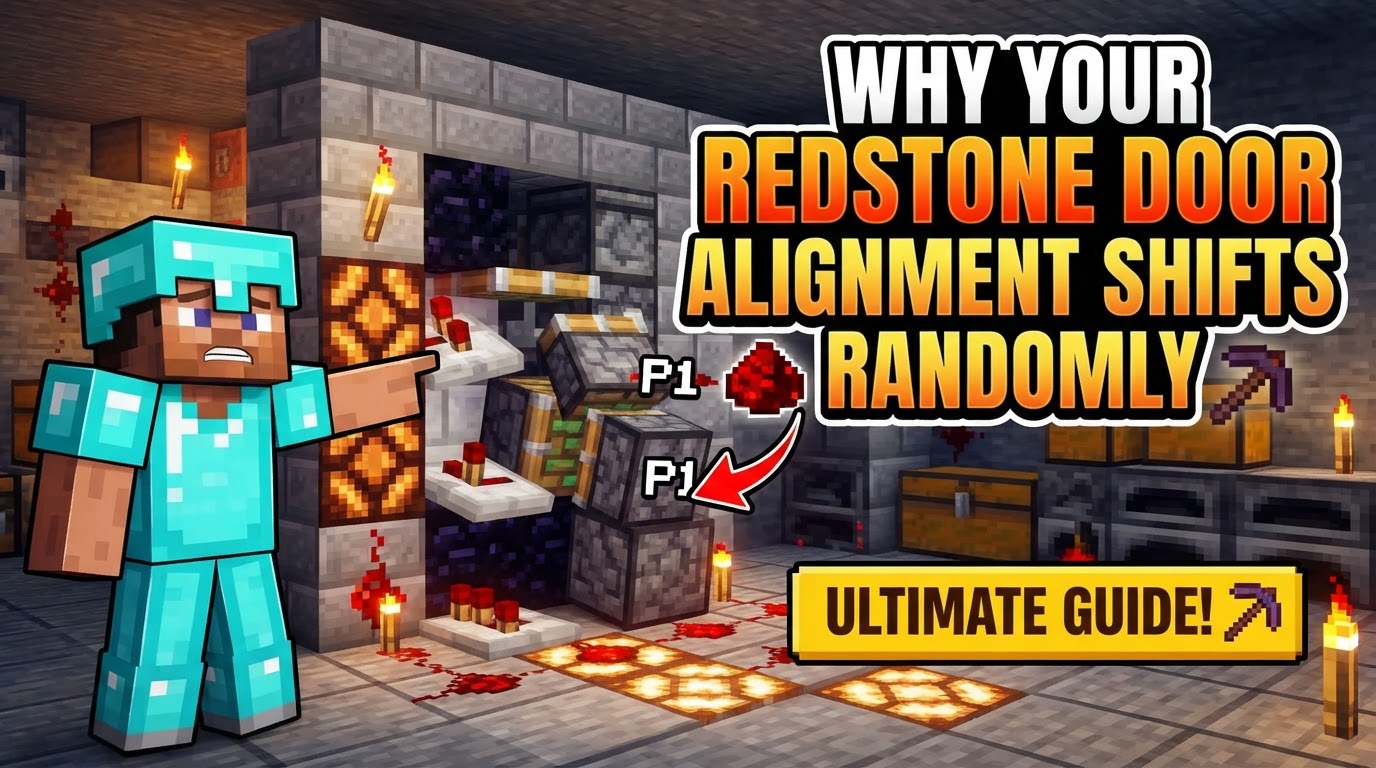
Understanding why your redstone door seems to develop a mind of its own requires delving into the underlying mechanics of redstone, particularly how they diverge between Minecraft’s two primary editions. What might appear as an erratic glitch is often a predictable outcome of specific game rules interacting in unexpected ways.
The Core Culprits: Understanding Redstone’s Quirks
The “random shifting” of redstone door alignment, especially in more intricate designs, can be attributed to several key mechanics and environmental factors. These are the primary reasons your carefully constructed door might betray your expectations.
Bedrock Edition’s Unpredictable Update Order
The single most significant cause of “random shifts” in redstone door alignment, particularly prevalent in Bedrock Edition, stems from its non-deterministic update order for redstone components. Unlike Java Edition, which generally follows a more predictable update sequence, Bedrock Edition offers no guarantees. When multiple redstone elements, such as pistons, are powered simultaneously, the game randomly determines which component updates first. This lack of a fixed order leads to inconsistent behavior, with pistons firing out of sync or in an unintended sequence. A door that worked perfectly once might fail on subsequent activations simply because a different piston extended a tick too early or too late.
The Phantom Menace: Chunk Loading & Unloading
Redstone contraptions, including advanced piston doors, are inherently vulnerable to issues arising from chunk loading and unloading. This phenomenon is a common source of malfunction, particularly on multiplayer servers and within Bedrock Edition. When the chunks containing your redstone system are unloaded (e.g., when a player moves too far away) and then reloaded, the redstone components can become desynchronized. This can cause pistons to get stuck, blocks to be left behind, or the entire mechanism to stop working until a player re-enters the chunk, forcing an update or reset. The state of components might not be preserved correctly across these loading cycles, leading to persistent alignment issues.
Piston Peculiarities: More Than Just Pushing
Pistons, the heart of any redstone door, have specific behaviors and limitations that, if not fully understood, can contribute to alignment shifts. Sticky pistons are designed to pull the block they are pushing back with them upon retraction. However, a common issue arises if a sticky piston is unpowered too quickly. This rapid unpowering can cause the piston to retract before it has a chance to pull its attached block, leaving the block behind and breaking the door’s alignment. Furthermore, pistons have a push limit of 12 blocks and cannot push immovable blocks like obsidian or bedrock, which can cause unexpected failures if these limits are inadvertently met within a design.
Directional Dependency (A Legacy Issue)
While less common in modern Java Edition builds, some redstone designs, especially older ones or those built in specific game versions, could exhibit different behaviors depending on the cardinal direction the contraption was facing. This directional sensitivity was often linked to how the game processed block updates based on coordinate systems (e.g., East/West vs. North/South axes). If you’re working with an older design or encountering inexplicable failures that seem tied to orientation, this historical quirk might be at play, though it’s less of a concern for contemporary Java Edition builds.
Quasi-Connectivity (Java Edition’s Unique Power)
In Java Edition, pistons possess a unique property known as quasi-connectivity, or BUD (Block Update Detector) power. This allows pistons to be activated by power sources located up to two blocks away, even diagonally, as long as a block update occurs adjacent to the piston. While quasi-connectivity is a powerful feature enabling compact designs, a misunderstanding or miscalculation of this mechanic can lead to unexpected piston activations or failures. If a power source inadvertently triggers a piston via quasi-connectivity, it can cause blocks to move out of sequence, leading to alignment shifts that appear random if the underlying mechanism isn’t recognized.
Diagnosing the Drift: Step-by-Step Troubleshooting
When your redstone door starts acting erratically, a systematic approach to troubleshooting is essential. Here’s how to diagnose and address the issues causing those frustrating alignment shifts.
Pinpointing Your Edition
The very first step is to definitively identify whether the problem occurs consistently in Java Edition or if it’s primarily a Bedrock Edition issue. This distinction is crucial because the solutions often differ significantly. Java Edition typically offers more predictable redstone behavior, while Bedrock Edition’s non-deterministic update order requires specific design considerations.
Observe, Isolate, Document
Don’t assume randomness. Repeatedly activate your door and carefully observe the exact components that are misbehaving. Is it always the same piston that fails to retract? Does a specific block get left behind? Take screenshots or record videos of the redstone wiring and the door’s behavior when it shifts. This documentation can help you identify subtle patterns or inconsistencies that might not be immediately obvious.
Strategic Delays: Taming Bedrock’s Chaos
For Bedrock Edition designs, where simultaneous powering of multiple components is a recipe for inconsistency, strategically introducing Redstone repeaters is paramount. These repeaters allow you to force a specific order of operation for pistons. For instance, if upper pistons need to extend before lower ones, place a repeater to slightly delay the lower pistons. This ensures that even with Bedrock’s random update order, your critical operations occur in the correct sequence, preventing blocks from being stuck or misaligned.
Ensuring Consistent Activity: Chunk Management
If your complex redstone door spans multiple chunks or is located in an area that frequently unloads, consistent chunk loading is vital. On servers or in Bedrock Edition, consider utilizing mechanisms like `ticking areas` (Bedrock) or dedicated `chunk loaders` (often more applicable to Java, though similar concepts exist in Bedrock through persistent entities) to ensure that all relevant parts of your redstone door remain active and loaded without interruption. This prevents desynchronization caused by chunks unloading and reloading.
The Directional Rebuild (When All Else Fails)
In rare cases, particularly with older or very specific designs that might be sensitive to directional processing, if a redstone door consistently fails in one cardinal direction, a pragmatic solution is to try rebuilding the entire contraption in a different direction. For example, if it fails when facing North, try rebuilding it facing South or East. This can sometimes bypass subtle directional bugs or quirks that are difficult to diagnose directly.
Avoiding Future Frustration: Best Practices and Common Pitfalls
Prevention is often easier than cure. By adopting best practices and understanding common mistakes, you can significantly reduce the likelihood of your redstone doors misbehaving.
Test Beds and Blueprints
Whenever designing or troubleshooting a redstone door, especially a complex one, build and test it in a flat world. This eliminates environmental factors like uneven terrain, nearby redstone signals, or other loaded entities that could interfere with your contraption. A flat world provides a clean, controlled environment for isolated testing and iteration.
Edition-Specific Expertise
Never assume cross-edition compatibility. Always seek out redstone tutorials, guides, and designs specifically tailored for your Minecraft edition (Java or Bedrock). Mechanics, especially around piston timing, update order, and quasi-connectivity, can differ fundamentally, making a Java design often incompatible with Bedrock, and vice-versa.
The Perils of Simultaneous Activation
A common pitfall, particularly in Bedrock Edition, is attempting to power multiple pistons or components at the exact same redstone tick without accounting for Bedrock’s random update order. This often leads to the “random shifts” discussed earlier. Designs must incorporate intentional delays to sequence activations properly, even if they appear to be simultaneous in Java Edition.
Overlooking Boundaries
Building large redstone contraptions that cross chunk borders without implementing mechanisms to keep all involved chunks loaded is a recipe for disaster. As discussed, chunk unloading can desynchronize or entirely break your door. Be mindful of chunk boundaries when planning large builds.
The Art of Timing: Delays Done Right
Insufficient or incorrectly set delays are a frequent cause of redstone door failures. Repeaters are your best friends for timing piston extensions and retractions. Failing to use them to properly sequence operations, or setting them to incorrect delay values, can lead to blocks being left behind, pistons getting stuck, or the entire door becoming desynchronized. Experiment and fine-tune repeater settings until your door operates smoothly and consistently.
Complex Door Considerations
For multi-layered piston doors (e.g., 3×3 or larger), the precise order in which pistons extend and retract is absolutely critical. A common mistake is not carefully managing this sequence, which can result in blocks being pushed into incorrect positions, left behind, or pistons becoming stuck. Complex doors require meticulous planning and careful timing of every piston’s movement.
Ultimately, the “random shifting” of your redstone door’s alignment is rarely random. It’s a direct consequence of specific game mechanics, particularly the differences between Minecraft editions, and how they interact with your design. By understanding these underlying principles and applying systematic troubleshooting, you can transform baffling failures into predictable, solvable challenges, ensuring your redstone doors operate with flawless precision.
Tags:
YOU MAY ALSO LIKE...