Create Big Cannons Wiki
Many a promising siege has ended not with a bang, but with a costly, self-inflicted explosion. The “Create Big Cannons” mod for Minecraft introduces a sophisticated and deeply rewarding system for engineering powerful artillery, but mastering its intricacies requires careful attention to detail. From the initial crafting of components to the precise loading and firing sequences, a single oversight can turn a magnificent war machine into a pile of twisted metal. This guide will illuminate the path to becoming a true master of blocky ballistics, ensuring your cannons deliver devastating payloads rather than devastating backfires.
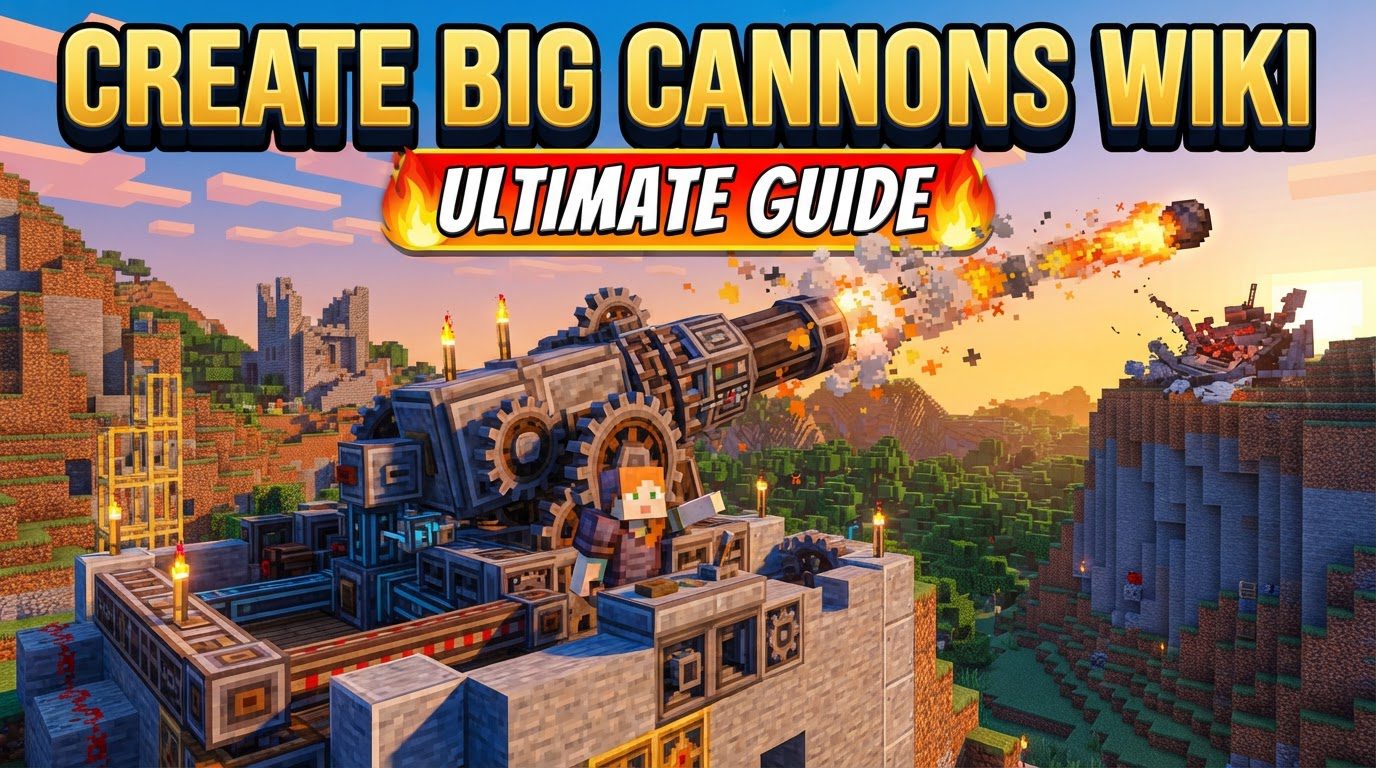
The Foundations of Firepower: Core Mechanics
At its heart, the Create Big Cannons mod is about modularity and realism. Unlike simpler block-based weapons, these cannons are complex assemblies, demanding a precise understanding of their constituent parts and operational principles.
- Modular Construction: Every cannon is a composite of distinct elements: a gun rotation controller, a cannon mount, various barrel sections, a specific end piece, and a muzzle. Each part plays a crucial role in the cannon’s function and capabilities.
- Material and Weight: The choice of material for your cannon components isn’t just aesthetic; it directly impacts its performance. Heavier, more robust materials will affect how easily a cannon can be moved, rotated, and even how it handles recoil.
- Powder Charges and Projectiles: Cannons are powered by powder charges, and their destructive potential is delivered by a variety of projectiles. These include heavy, armor-piercing, mortar, and shrapnel rounds, each designed for specific effects and tactical applications.
- Loading Methods: Not all cannons load the same way. Some are breech-loaders, allowing for rear loading, while others, particularly those made of cast iron or forged iron, are strictly muzzle-loading and require charges and projectiles to be inserted from the front.
- The Squib Ratio: This is a vital safety mechanic. The squib ratio dictates the maximum permissible barrel length per powder charge. Exceeding this ratio will inevitably lead to the cannon exploding upon firing, even if initial tests with fewer charges seem successful.
- Kinetic Control: The mod leverages kinetic energy, a core mechanic of the Create mod, to power and control cannon aiming and other functions, integrating seamlessly into existing Create contraptions.
- Automation Potential: For those looking to streamline their artillery operations, the mod fully supports the automation of both loading and firing processes.
- Fuzes for Precision: Projectiles can be enhanced with various fuzes-impact, proximity, or timed-to modify their detonation behavior. This significantly increases their tactical versatility and destructive impact.
- Assembly Integrity: For a cannon to function correctly and avoid catastrophic failure, it must always maintain exactly one open end and one closed end. This fundamental rule ensures structural integrity and proper firing mechanics.
From Blueprint to Blast: A Step-by-Step Guide
Constructing and firing a cannon in Create Big Cannons is a multi-stage process that rewards meticulous planning and execution.
1. Component Crafting: Forging the Molds
Your journey begins with crafting the necessary molds. Use a mechanical saw to create wooden molds. Be aware that the mold crafting process can be somewhat random, so you may need to craft several to get the specific molds for each distinct cannon part you intend to build.
2. Material Casting: Molten Metal to Solid Steel
Once you have your molds, it’s time for casting. Melt materials like cast iron in a heated bowl. Then, utilize pipes and mechanical pumps to extract the molten metal and pour it into your molds, shaping the individual components of your cannon.
3. Cannon Assembly: Bringing it All Together
The assembly process dictates your cannon’s final form and function:
- Place a Gun Rotation Controller as the base. This block serves as the pivot point for your cannon.
- Directly on top of the controller, mount the Cannon Mount. This connects the barrel assembly to the rotation mechanism.
- Attach your chosen barrel sections, the appropriate cannon end, and finally the muzzle to complete the cannon’s physical structure.
- For Mobile Cannons: Once assembled, right-click a trolley block with a wrench. This will transform your cannon into a movable contraption.
- For Stationary Cannons: To finalize assembly and lock it in place, activate a lever placed on the “hammer” side of the cannon mount.
4. Loading Procedures: Arming Your Artillery
Proper loading is paramount to preventing explosions:
- If you are using a breech-loading cannon, you might need to partially disassemble the rear section to access the loading chamber. However, remember that many cannon ends (like cast or forged iron) are for muzzle-loading only and will not open.
- Carefully insert your powder charges, followed by your chosen projectile, into the cannon.
- Crucially, use a gun loader in conjunction with a pushing nozzle to ensure that both the powder charges and the projectile are fully pushed to the cannon’s end. Any gap can lead to an explosion.
- If you disassembled any part for loading, reassemble the cannon before attempting to fire.
5. Control and Firing: Unleashing the Barrage
With your cannon loaded, it’s time for the moment of truth:
- Assign specific keybinds for cannon control within your Minecraft settings. Key functions include a “channel speech mod” key for muzzle elevation, A/D for horizontal rotation, and a dedicated fire control key.
- To aim, seat yourself at the gun. Hold the assigned “channel carriage mod” key along with W/S to adjust the muzzle elevation. Use A/D to rotate the cannon horizontally.
- When your target is acquired, press the designated fire control key to discharge the cannon. Stand back and observe the devastation!
Maximizing Your Arsenal: Advanced Tips
Beyond the basics, several strategies can enhance your cannon operations:
- Material Matters: The material and overall weight of your cannon directly influence its maneuverability. Lighter cannons will rotate and move faster, while heavier ones offer greater stability but slower adjustments.
- Mobile Cannon Management: While powerful, larger mobile cannons are inherently more challenging to turn and reposition. Design your mobile platforms with this in mind, perhaps incorporating more powerful rotational mechanisms.
- Custom Keybinds: Fine-tune your control scheme. Customizing keybinds allows for precise and intuitive adjustments of functions like muzzle elevation, crucial for hitting distant or moving targets.
- Automated Rate of Fire: For automated cannon setups, a wheel can be ingeniously integrated to adjust the rate of fire, allowing for anything from a slow, deliberate bombardment to a rapid-fire barrage.
- The Power of Fuzes: Never underestimate the impact of fuzes. Unfused autocannon rounds are significantly less effective. Applying impact, proximity, or timed fuzes can dramatically increase their destructive potential and tactical utility.
Avoiding Catastrophic Failures: Common Mistakes
Even seasoned players can fall victim to common errors. Heed these warnings to prevent your cannons from becoming self-destructive:
- Improper Loading: This is perhaps the most frequent cause of cannon explosions. Failing to fully push both powder charges and projectiles to the very end of the cannon’s barrel will invariably result in an explosion upon firing. Always confirm they are seated correctly.
- Incorrect Piston Use: If you’re using pistons to manipulate cannon parts, never attempt to break a piston extension without first removing any nozzles from the cannon. Doing so can cause irreparable damage to your cannon.
- Object Clipping: Firing an assembled cannon while its chamber or barrel is clipping (overlapping) with any other solid block or object will cause the cannon to explode. Ensure a clear firing path and surrounding area.
- Ignoring the Squib Ratio: This critical safety measure is often overlooked. Disregarding the maximum safe barrel length per powder charge, even if initial short-barrel tests seem fine, will lead to an explosion when you build longer barrels or use more charges. Always calculate and adhere to the squib ratio.
- Assembly Errors: A cannon must always have exactly one open end and one closed end. Duplicating cannons via schematics or building them manually can sometimes introduce errors if this rule is violated, leading to an unstable or non-functional cannon.
- Muzzleloader Misconception: Do not expect “regular” cannon ends, such as those made of cast iron or forged iron, to open for breech-loading. These specific types are designed exclusively for muzzle-loading, and attempting to load them from the rear will be futile.
Mastering the Create Big Cannons mod is a journey of engineering, precision, and careful learning. By understanding its core mechanics, adhering to proper construction and loading protocols, and heeding these warnings, you can build formidable artillery pieces that dominate the battlefield and stand as a testament to your Minecraft ingenuity.
Tags:
YOU MAY ALSO LIKE...