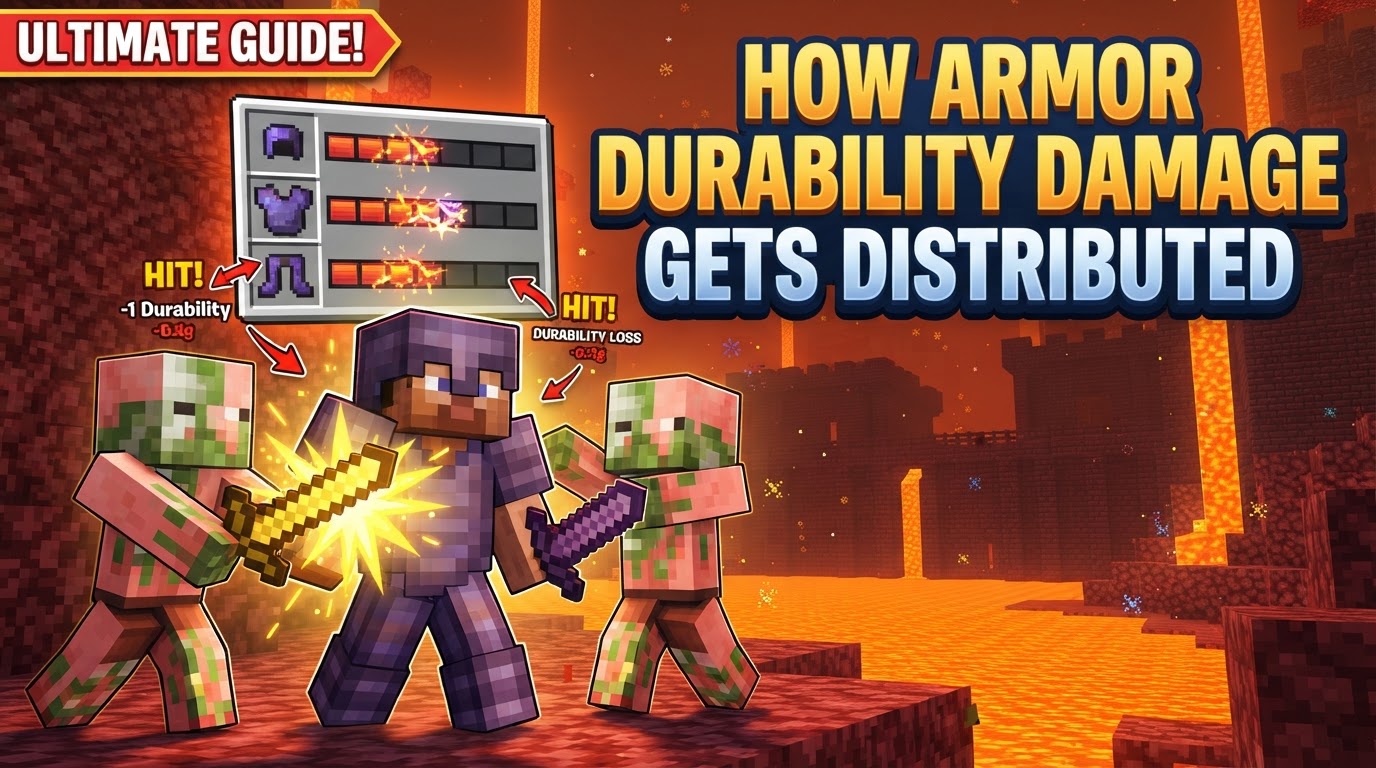
How Armor Durability Damage Gets Distributed
A single attack in Minecraft, whether from a zombie’s clumsy swing or a falling block, doesn’t just chip away at your health bar; it initiates a complex durability assessment across every piece of armor you’re wearing. This often-overlooked mechanic, where all equipped armor takes damage simultaneously, is fundamental to understanding armor maintenance and longevity in the blocky world.
Understanding the Core Mechanic: Simultaneous Damage Distribution
One of the most crucial aspects of armor durability in Minecraft is that when a player takes damage, durability is generally reduced on all equipped armor pieces simultaneously. This means that a single blow that would normally inflict 8 hit points (4 hearts) of damage will cause your helmet, chestplate, leggings, and boots to each lose 1 durability point, assuming no enchantments interfere. This consistent application of durability loss across the entire set, irrespective of where the player is “hit,” highlights the importance of maintaining all armor pieces rather than just focusing on one.
The Math Behind the Wear: Initial Damage and Durability Loss
The calculation for durability loss is surprisingly straightforward but often misunderstood. For every 4 hearts (equivalent to 8 hit points) of the initial incoming damage – that is, the damage the player would have taken without any armor protection – each equipped armor piece loses 1 durability point. This initial damage value is critical; it’s not the reduced damage you actually suffer, but the raw damage before your armor’s protective qualities kick in. This mechanic ensures that even highly protective armor sets will still accumulate durability damage at a predictable rate based on the threat level, not just the residual damage.
Factors Influencing Protection and Durability
While durability loss is tied to raw incoming damage, the actual protection your armor provides is vital for survival. Armor reduces incoming damage, with a full set capable of providing up to 20 armor points, translating to an 80% damage reduction. Furthermore, armor toughness, a statistic found exclusively on diamond and Netherite armor, plays a significant role. It reduces the effectiveness penalty against high-damage attacks, meaning these superior materials maintain their damage reduction capabilities more effectively against powerful foes. Each armor piece also possesses a base durability determined by its material, ranging from the lowest for leather to the highest for Netherite, which inherently affects how long it can withstand this consistent durability drain.
The Step-by-Step of Durability Loss
To fully grasp how your armor wears down, it’s helpful to break down the process into sequential steps:
- Player Takes Damage: The process begins when the player is subjected to damage, whether from an enemy attack, environmental hazards like fire or lava, or other damaging sources.
- Damage Calculation: The game first calculates the raw, unmitigated damage that the player would take. Following this, it applies the player’s armor points, armor toughness, and any protection enchantments to determine the actual damage the player receives.
- Durability Reduction: Crucially, for every 4 hearts (8 hit points) of that initial incoming damage (before any armor reduction), every single equipped armor piece simultaneously loses 1 durability point. This universal reduction happens regardless of which part of the player model appears to be “hit.”
- Unbreaking Check (if applicable): If an armor piece has the Unbreaking enchantment, for each durability point it would normally lose, the game performs a random check. This check determines if the durability loss is prevented, effectively extending the item’s lifespan.
- Thorns Check (if applicable): Should an armor piece be enchanted with Thorns, and if that enchantment triggers to deal damage to an attacker, the specific armor piece with Thorns loses additional durability. It loses 3 durability points when Thorns successfully deals damage and 1 point even if it fails to deal damage but still triggers.
- Special Cases: It’s important to note that certain damage types behave differently. Fall damage, for instance, uniquely affects only boots and reduces their durability based on the height of the fall. Conversely, some damage sources, such as void damage, drowning, starvation, poison, and the Wither effect, do not affect armor durability at all.
Enchantments: Your Armor’s Best Friends (and Foes)
Enchantments are pivotal in managing and influencing armor durability. They can significantly extend the life of your gear or, in some cases, accelerate its decay.
- Unbreaking: Extending Lifespan: The Unbreaking enchantment is a cornerstone of armor longevity. It provides an item with a chance not to lose durability when it normally would. At its highest level, Unbreaking III offers approximately a 30% chance to save durability for armor, translating to a substantial increase in the item’s effective lifespan.
- Mending: The Self-Repairing Solution: Mending is a “treasure enchantment” that revolutionizes armor maintenance. When an item enchanted with Mending is equipped, it repairs its durability by converting collected experience orbs. Each experience point restores 2 durability points. If multiple Mending items are equipped and damaged, the game randomly chooses one to repair per orb, making XP farms incredibly valuable for continuous armor upkeep.
- Thorns: A Double-Edged Sword: While offering a defensive benefit by damaging attackers, the Thorns enchantment comes at a significant durability cost. The armor piece it’s on loses additional durability (3 points when successful, 1 when not) every time it triggers. This accelerated wear can quickly deplete an armor piece’s durability, making it a trade-off players must consider.
Strategic Armor Maintenance: Keeping Your Gear Intact
Effective armor management goes beyond just crafting new sets. Understanding repair methods is key to preserving your valuable enchanted gear.
- The Mending-Unbreaking Synergy: Combining Mending and Unbreaking is arguably the most effective strategy for armor maintenance. Unbreaking significantly reduces the rate of durability loss, meaning Mending becomes far more efficient as fewer XP orbs are required to keep your gear fully repaired. This synergy creates a near-indestructible armor set under normal gameplay conditions.
- Leveraging XP Farms: With Mending-equipped armor, a steady source of experience points – easily obtained from mob farms, mining, or smelting – allows for continuous and automatic repair of all worn Mending gear. As you collect XP, your armor simply repairs itself.
- Anvil Repairs for Enchanted Gear: To repair enchanted armor and preserve its valuable enchantments, the anvil is your primary tool. Place the damaged armor in the anvil’s first slot and the base crafting material (e.g., diamonds for diamond armor) in the second. This process costs experience levels, which increase with the item’s enchantments and prior repairs. Additionally, two damaged enchanted items of the same type can be combined on an anvil to merge and repair their durability, potentially combining enchantments, albeit at an experience cost.
- Crafting Grid & Grindstone for Basic Repairs: For unenchanted armor, simpler repair methods exist. Two damaged, unenchanted armor pieces of the same type can be combined in a crafting grid to merge their durability, often with a small bonus. Similarly, grindstones can combine two damaged unenchanted armor pieces, adding a 5% durability bonus. However, these methods are not suitable for enchanted items.
Avoiding Costly Blunders: Common Durability Mistakes
Even experienced players can make mistakes that lead to unnecessary armor loss or expensive repairs.
- Grindstones and Enchantments: A common and costly error is attempting to use a grindstone to repair enchanted armor. While grindstones can repair unenchanted items, they will irrevocably remove all enchantments from an item in the process, rendering valuable gear significantly less potent. Always use an anvil for enchanted repairs.
- Overlooking Unbreaking: While Unbreaking’s benefit might seem less dramatic on armor compared to tools, ignoring this enchantment for your protective gear is a mistake. It significantly extends the lifespan of armor, especially when paired with Mending, reducing the frequency and cost of repairs.
- Proactive vs. Reactive Repairs: Waiting until valuable armor breaks completely before attempting repairs can be detrimental. Not only does it leave you vulnerable, but it can also lead to the complete loss of the item if it breaks in a dangerous situation, or necessitate costly replacements. Regular checks and proactive repairs, especially with Mending, are far more efficient.
- The Hidden Cost of Thorns: Players often underestimate the significant durability cost associated with the Thorns enchantment. While its defensive capabilities are undeniable, Thorns can rapidly accelerate the wear and tear on armor, particularly on chestplates due to their higher base durability. Factor this into your repair strategy or consider if Thorns is truly necessary for your playstyle.
Mastering armor durability distribution and management is a cornerstone of long-term survival and progression in Minecraft. By understanding how damage is applied, leveraging powerful enchantments like Mending and Unbreaking, and employing smart repair strategies, players can ensure their protective gear remains intact, allowing them to face the game’s toughest challenges with confidence.
Tags:
YOU MAY ALSO LIKE...